


A small dinner can make meeting new people feel more natural than another round of online introductions. Whether After5 is worth it depends on what you’re looking for: its dinners bring together four to six women, with a prepaid menu arranged in advance. If you want a relaxed setting to meet women and explore the possibility of genuine friendship, that format may suit you. If you’re hoping for a guaranteed instant connection, one dinner can’t promise that.
It’s understandable to want new friends and still feel unsure about walking into a room of strangers. A thoughtful format can take some of the pressure off, while shared conversation gives connection space to grow. This article explains how After5 dinners work, what the experience can offer, and how to decide whether it fits your plans in Amsterdam. You’ll get a clear sense of what happens around the table, who may enjoy the format, and when a friendship-focused membership or gathering may be a better match for the way you want to meet people.
Key Takeaways
- Understand how a dinner is organized, including the role of its prepaid menu, before deciding whether the format suits your evening.
- See what can help conversation with new people feel more natural, and why friendship takes more than one shared meal.
- Learn how to assess user reviews thoughtfully without treating individual experiences as a promise of your own results.
- Compare friendship-focused gatherings with other ways of meeting people by considering the kind of connection and experience you want.
- Explore which After5 offering may align with your next step toward meaningful new friendships.
How After5 dinners work
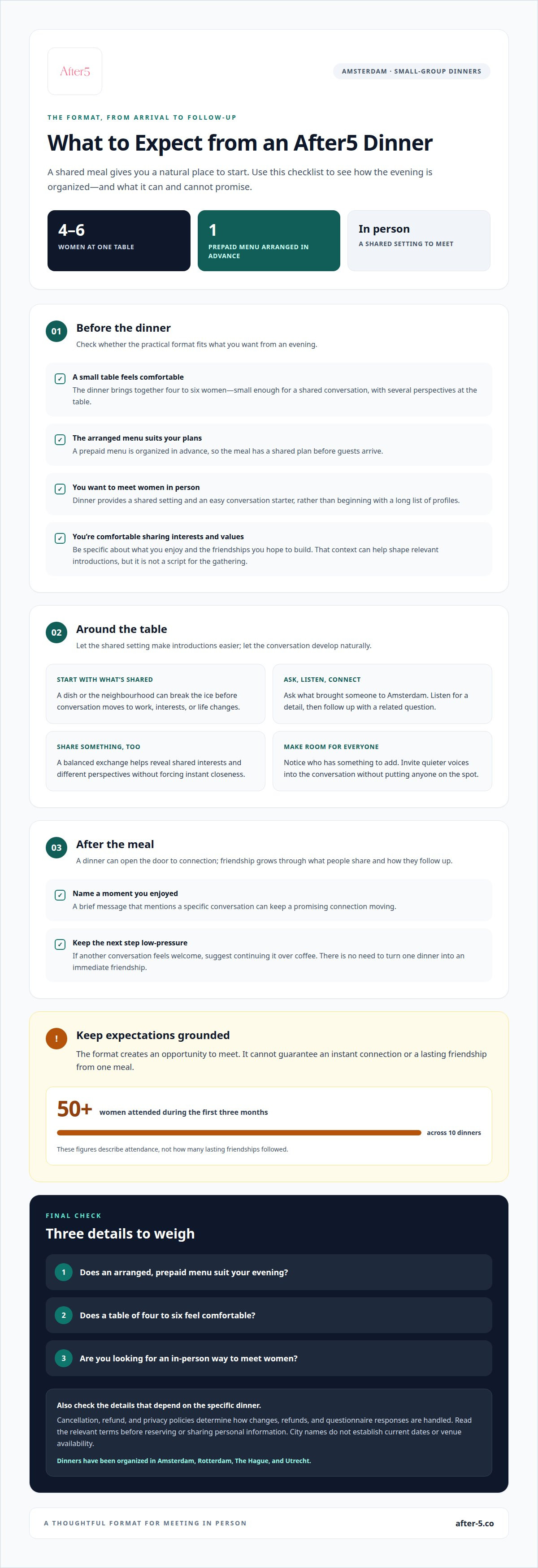
Each dinner brings together four to six women around one table. A prepaid menu is arranged in advance, so the meal has a shared plan before guests arrive. That small-group format creates room for everyone to join the conversation. It also gives you a clearer picture of the experience than a large, open gathering would.
The dinner is designed around meeting women in person over a meal. Rather than beginning with a long list of profiles, the evening gives guests a shared setting and a natural conversation starter: dinner. For example, talking about a dish or the neighbourhood can help break the ice before the conversation moves to work, interests, or life changes.
When you sign up, share your interests and values honestly. That context can help shape relevant introductions and group connections, but it is a starting point, not a script for the Gathering. Specific details about what you enjoy and the friendships you hope to build can give others an easy way to start a conversation.
The group size matters. With four to six women, a table is small enough for a shared conversation, while still bringing several perspectives into the room. You might meet someone whose interests closely match yours, or someone whose different experiences give you a fresh point of connection. The format creates an opportunity to connect; friendship develops through what people share and how they follow up.
Amsterdam is among the cities where dinners were organized, alongside Rotterdam, The Hague, and Utrecht. The local option described here is a small-group dinner with a prepaid menu; the format gives guests a planned meal and an in-person setting to meet. City names alone don’t establish which dates or venues are currently available, so they shouldn’t be read as a schedule.
Cancellation, refund, and privacy terms matter if plans change or sign-up involves personal information. The relevant policy details determine how cancellations are handled, whether refunds apply, and how questionnaire responses are treated. Read those terms before reserving or submitting personal details; the dinner format itself does not establish those policies.
In practical terms, consider three points before choosing a dinner: whether an arranged menu suits you, whether a table of four to six feels comfortable, and whether you want an in-person way to meet women. Those details make the format easier to evaluate against your plans in Amsterdam, without assuming that one meal guarantees a lasting friendship.
Horecatrends says that dinners were being organized through Twitter in 2008. This provides historical context for the dinner format, but does not establish how After5's present-day sign-up, group selection, or policies work. For a current decision, consider the details of the specific dinner rather than treating that history as evidence of availability or terms.
Meeting women and making friends
Meeting women is a first step; building friendship takes more than one conversation. A shared activity can make introductions easier by giving everyone a natural starting point. From there, small gestures matter: remembering someone’s interest in art, asking about her move to Amsterdam, or suggesting you continue the conversation another time. These moments make room for connection without forcing instant closeness.
The format is best suited to women who want meaningful new friendships and are open to meeting people with different experiences. It may feel especially relevant during a life transition, such as moving to Amsterdam or entering a new stage of work or study. The period from 25 to 35 is often marked by significant changes, so an intentional way to meet peers can feel timely during those years.
Early participation shows the dinners brought women together in person: more than 50 women attended during the first three months, across 10 dinners. Those figures describe attendance, not how many lasting friendships followed. The useful takeaway is narrower: a meal creates a setting for introductions and shared conversation, while what happens afterward depends on whether people choose to stay in touch.
When you create your profile, be specific about the kind of friendship you hope to find. Mentioning that you enjoy quiet weekends, creative projects, or exploring Amsterdam’s neighbourhoods gives a more personal picture than a broad label like “social.” Concrete interests give others an opening to ask questions and help conversations move beyond small talk.
In a first conversation, try a simple sequence: ask what brought someone to Amsterdam, listen for a detail, then ask a related question. If she mentions discovering local cafés, you could ask which neighbourhood she enjoys. Share something about yourself too. A balanced exchange makes it easier to notice shared interests, different perspectives, and whether another conversation feels welcome.
After meeting, a brief message can keep a promising conversation moving. Mention the specific topic you enjoyed, then suggest a low-pressure next step, such as continuing that conversation over coffee. There’s no need to turn one dinner into an immediate friendship. If you’re looking for a structured way to keep meeting women with friendship in mind, explore a friendship-focused membership as one possible next step.
After5 dinners bring together between 4 and 6 women at a table. A group of this size can leave room for everyone to contribute while keeping the conversation relaxed. You might arrive with a question you genuinely want to ask, but let the discussion move naturally rather than treating the evening like a checklist. Notice who shares an interest you’d like to hear more about, and make space for quieter voices by inviting them into the conversation without putting them on the spot.
Before you leave, tell someone you enjoyed talking with her and ask whether she’d like to stay in touch. A warm, specific invitation gives you both an easy way to continue the conversation, while leaving room for the connection to develop at its own pace.
What is After5 and what services does it offer?
It is a friendship platform for women seeking meaningful new connections. Its focus is personal, not transactional: bringing people together around shared values, interests, and life chapters. That distinction matters when choosing how to meet new friends. For example, someone hoping to find thoughtful conversation may value an introduction shaped around common interests more than an open-ended social directory.
Circles are curated community groups based on interests, career, life stage, or other shared traits. A common interest or life chapter gives members an easy starting point. For example, a Circle for women interested in Amsterdam’s creative scene can bring people together around a shared topic, while their individual experiences give conversations room to develop.
Gatherings offer another way to meet in person. These curated small-group meet-ups can include dinners, brunches, drinks, or themed events. A shared setting gives conversation a natural focus, whether you’re discovering a new place or exchanging stories about a recent move. Gatherings suit women who prefer face-to-face conversation; food and drinks are included only when the event description explicitly says so.
Personalized introductions provide a more direct route to connection. Instead of relying only on broad categories, introductions can reflect a woman’s interests and values. For example, someone who values curiosity, creative projects, and close friendships may have more useful common ground with a person who shares those qualities. The aim is a relevant introduction, not a promise that every match will become a close friend.
Together, Circles, Gatherings, and Alike offer different ways to build connections. If you enjoy meeting several people at once, you might prefer a Circle or Gathering. If you want a more focused introduction, Alike may be a better fit. Shared interests can open a conversation, while compatible values can give a friendship room to grow.
Choose a format based on the experience you want. Consider whether you feel more at ease in a group, at a curated Gathering, or in a one-to-one introduction through Alike. Then think about what you’d like to share with new friends, such as exploring Amsterdam, talking about a career change, or making space for more meaningful conversations. The right format is one that makes meeting people feel intentional and comfortable, while leaving room for connections to develop naturally.
What do After5 users say in recent reviews?
To assess recent user reviews, look for dated comments from identifiable review sources that describe specific experiences. Without those details, it would be inaccurate to claim that users praise Gatherings, criticize matching, or report lasting friendships. Treat such statements as individual review claims only when they can be tied to an actual published comment.
When reading reviews, separate three parts of the experience: signing up, meeting in person, and what happens afterward. A comment about an easy profile setup describes onboarding. One about feeling included at a Gathering describes the event. A story about staying in touch describes a later outcome. These are different experiences, so a positive comment about one does not represent the whole service.
Look for specific details instead of broad labels. “I met women who had also recently moved to Amsterdam” gives more context than “great experience.” Details can help you judge whether a reviewer’s situation resembles yours. Check the date too: a review from an earlier period may describe a format that has changed, while a recent comment may better reflect the experience being discussed.
Read praise and criticism with the same care. If a reviewer says conversation felt easy, consider what they explain about the group or setting. If someone mentions a mismatch, distinguish personal preference from an issue repeated across independent comments. One person preferring one-to-one introductions, for example, does not establish that small-group Gatherings suit nobody.
Review volume is useful context, not proof. A few detailed comments can offer examples, but they cannot establish a universal outcome. A high rating alone also leaves questions unanswered: does it reflect profile setup, a Gathering, or friendships made afterward? Look for several comments about the same part of the experience before treating a theme as representative.
For your own decision, use a simple three-step test: identify what each review discusses, note whether it gives a specific example, and compare that detail with what you want from meeting people in Amsterdam. A review about feeling comfortable at a Gathering may help if social ease matters to you. A story about a lasting friendship describes a different outcome and remains one person’s experience, not a promise.
Without traceable recent comments, no particular praise, complaint, rating, or recurring user opinion can be responsibly attributed here. That distinction keeps the decision grounded: judge the format by the details available in the article, and treat personal review stories as individual accounts rather than guaranteed results.
How does After5 compare with its main alternatives?
In Amsterdam, the right way to meet new people depends on how you prefer to begin. A curated dinner offers a planned, face-to-face introduction, while friendship platforms often start with profiles and messages. The practical difference is the first step: conversation around a table, or deciding whether to continue a digital exchange. If you’re asking, “Is After5 worth it?” consider which kind of introduction feels more natural to you.
Open social gatherings create another route. A language exchange or community meet-up can bring people together around a shared activity, such as practicing a language or exploring a local interest. That common focus can make first conversations easier. The trade-off is that you may need to start conversations yourself and find people whose friendship goals align with yours. A planned dinner puts meeting people at the center of the experience.
Friends-of-friends introductions offer existing social context. A mutual friend may help start a conversation or provide a connection point, such as a shared workplace or neighbourhood. But this route depends on who is already in your circle. If you’re new to Amsterdam, or your friends have different schedules, an organized introduction may offer a more direct way to expand your social world.
Use three questions to compare these options. Do you want to meet in person immediately, or begin by messaging? Would a shared activity help conversation, or would you rather focus on getting to know someone? Are you looking for a single social occasion or a more intentional path toward friendship? Your answers can help you choose between a dinner, an online platform, an open gathering, and a personal introduction.
Consider the effort involved, too. On a friendship platform, you create a profile and decide which conversations to pursue. At an open gathering, you choose whom to approach and how to keep a conversation going. A curated introduction can reduce broad searching, but you still need to participate and decide whether to stay in touch. A useful way to decide whether After5 is worth it is to weigh that format against the effort and pace you prefer.
If you value a considered route toward meeting compatible people, explore a friendship-focused membership as one option. If you’d rather meet people through an activity or existing contacts, those routes may suit you better. Compare how each option helps you connect, then choose the approach that feels aligned with the friendships you want to build in Amsterdam.
After5
After5 is a friendship platform for women seeking meaningful new connections. Its After5 Membership, Gatherings, Circles, and Alike offer different ways to discover women with shared interests, values, or life chapters. If you’re weighing a dinner against other ways to meet people in Amsterdam, consider whether a friendship-focused setting fits the kind of connection you want to build. A shared conversation can be a beginning, while ongoing connection grows through mutual interest and follow-up.
Choose this path if you want meeting women and making friends to feel more intentional than open-ended online browsing. If you’d like to explore a considered, in-person approach, contact After5 to learn more.
Make room for a new connection
Choosing whether After5 is worth it comes down to the kind of social life you want to create in Amsterdam. If meeting new women feels like a priority, treat the next step as an invitation to make space for conversation, not a test you need to pass. You don’t need a perfect introduction or a fully formed friendship plan. Bring your curiosity, be open about what matters to you, and let connection develop at a human pace.
Before choosing your next step, consider what would make a new friendship meaningful to you. Maybe you want someone for honest conversations, exploring Amsterdam together, or a familiar face to message after a long day. Naming that hope can help you approach new connections with intention while staying open to the unexpected.
Small choices can shift a routine: saying yes to a new setting, sharing a little more about yourself, or following up when a conversation feels promising. Take things at your own pace. Each genuine exchange gives a new connection room to grow.
Contact After5 about your dinner plans and take a thoughtful first step toward meeting women in Amsterdam.
Frequently Asked Questions
How much does After5 cost, including fees and subscriptions?
After5 has subscription and gathering-pass options, so your total depends on how you choose to participate. Membership renews automatically unless cancelled before its renewal date. Subscription payments and confirmed gathering bookings are generally non-refundable. Before selecting an option, consider whether you want recurring access or a single gathering, and account for renewal and booking terms in your decision.
What are the main benefits and drawbacks of After5?
The main benefit is a friendship-focused way to discover people through shared interests and life stages, rather than relying only on chance encounters. The format still requires you to participate and follow up if a conversation feels promising. A match or introduction can create an opportunity, but it can’t guarantee a lasting friendship. Consider whether you’re comfortable building connection gradually through conversation.
How does a friendship platform support sign-up and getting started?
Getting started begins with creating a profile and sharing an authentic picture of yourself. Profile creation, browsing Circles, sending Likes, and chatting after mutual Likes are available without a subscription. Use a recent, authentic personal photo: fake or misleading images are not permitted and may lead to account suspension or deletion. To join Gatherings or receive Alike introductions, review the subscription and event details in the app.