


A cancellation request and a lost-policy release are different things. The After5 gathering cancellation policy is about what happens when someone can no longer attend; a lost-policy release is an insurance document, not a gathering cancellation. Refunds and effective dates depend on the terms that apply to the specific booking, so it helps to separate the request from its outcome.
Plans change, and it’s natural to want a clear answer about what to do next. A message asking to cancel doesn’t, by itself, explain whether a refund applies or when the cancellation takes effect.
This guide unpacks the difference between a cancellation request and a lost-policy release, explains how to think about timing and refunds, and shares practical ways to keep important notices from slipping past. You’ll have a clearer sense of which details matter and what to look for when plans shift, without adding more guesswork to an already busy moment.
Key Takeaways
- Distinguish a cancellation request from a lost-policy release; they serve different purposes and don’t mean the same thing.
- Pin down the effective date and time in the applicable notice or policy documents, since timing can affect what happens next.
- Refunds depend on the reason for cancellation and the terms that apply, so identify which type of cancellation is involved.
- Notice periods vary by state and by cancellation reason; some states allow electronic delivery when the policyholder has consented.
- Keep cancellation communications organized, including electronic messages and certified-mail return receipts, to help prevent missed notices.
Cancellation request versus lost policy release
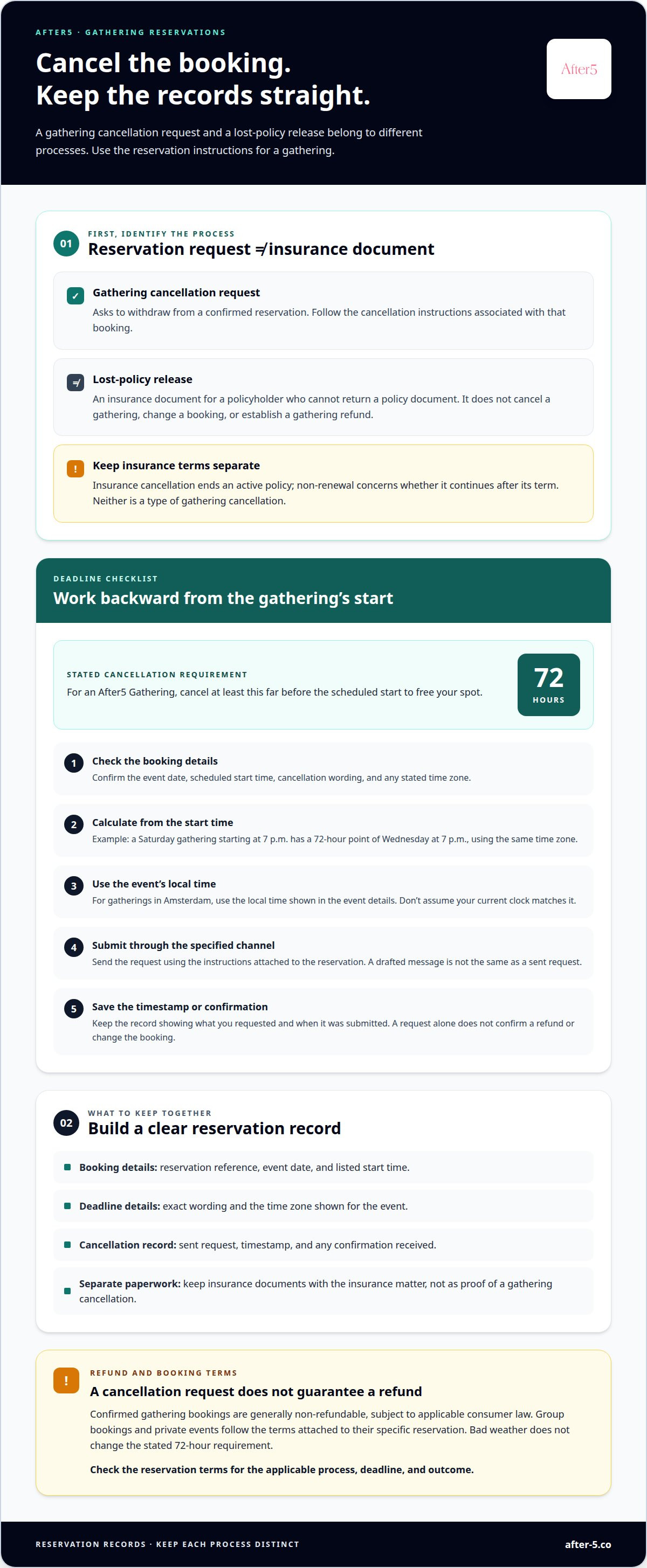
A gathering cancellation request asks to withdraw from a confirmed reservation. A lost-policy release is an insurance document for a policyholder who cannot return a policy document; it is not a form for cancelling an After5 Gathering. Keep the distinction clear: use the reservation’s cancellation process for a gathering, and don’t treat an insurance document as proof that a booking was cancelled.
For an After5 Gathering, cancel at least 72 hours before its scheduled start time to free your spot. For example, if the gathering begins at 7 p.m. on Saturday, the 72-hour point is 7 p.m. on Wednesday. Submit the request using the instructions associated with the reservation, and retain its timestamp or confirmation.
A lost-policy release does not cancel a gathering, change its booking, or establish a gathering refund. It belongs to a separate insurance process. If you have a confirmed reservation in Amsterdam, use its event details and cancellation instructions instead. The reservation and any cancellation confirmation are the relevant records for that request.
Cancellation and non-renewal are also insurance terms, not two types of After5 Gathering cancellation. Cancellation ends an active insurance policy; non-renewal concerns whether that policy continues after its term. For a gathering, focus on the booking’s start time and the 72-hour cancellation requirement. Don’t apply an insurance policy term to an event reservation.
Group bookings and private events follow the cancellation terms attached to the specific reservation. The available terms don’t establish a separate rule for either category, so don’t assume a group booking has a different deadline. Check the reservation details for its start time and cancellation instructions, then use the same stated process for that booking.
Bad weather does not change the stated 72-hour cancellation requirement. If weather affects your plans, the confirmed booking remains subject to its cancellation terms: cancel at least 72 hours before the gathering starts to free your spot. Confirmed gathering bookings are generally non-refundable, subject to applicable consumer law.
Keep the categories distinct: a gathering request concerns a reservation, a lost-policy release concerns an insurance document, and non-renewal concerns an insurance policy’s continuation. For an Amsterdam gathering, follow the booking’s cancellation instructions and preserve the confirmation. That record helps show which reservation you meant and when you submitted your request.
An ACORD cancellation request belongs to the insurance side of this distinction, not to the gathering reservation. The named insured signs an ACORD cancellation request, and carriers often require every named insured to sign. Those signatures relate to the insurance request; they do not serve as a gathering cancellation confirmation or show that a reservation was withdrawn. Keep the insurance paperwork apart from the booking’s cancellation record, and use the reservation instructions when the goal is to cancel a gathering.
If both matters arise, treat them as separate requests and keep their records distinct. The insurance document does not replace the reservation’s cancellation process, while a gathering cancellation request does not stand in for an insurance request. Check which process applies before submitting paperwork, and retain the relevant confirmation with the corresponding request. This keeps the reservation record connected to the gathering and the ACORD request connected to the insurance matter.
Cancellation date and time
A cancellation deadline only has meaning alongside its stated date, time, and time zone. A line that says “submit by Friday” leaves room for confusion: Friday where, and before which hour? Look for the exact wording in the booking terms or confirmation. If a deadline says “72 hours before the gathering,” calculate from the scheduled start time, not from the day alone.
The scheduled start is the reference point in that example. If a gathering begins at 7 p.m. on Saturday, a 72-hour cutoff would point to 7 p.m. on Wednesday, using the same time zone. That calculation illustrates the wording; it doesn’t establish that every booking has a 72-hour cancellation window. The terms must state whether that deadline applies.
Separate the moment you send a request from the moment it is received or processed. A message drafted before a cutoff but sent afterward has a different timestamp from one delivered beforehand. For a clear record, use the cancellation channel named in the booking information, submit the request, and keep the confirmation showing its date and time.
Time zones matter for travelers attending gatherings in Amsterdam. Someone arriving from a different time zone should use the local time shown in the event details, rather than assuming their current clock matches it. Use the time zone attached to the event when interpreting its start time and any stated cutoff. Daylight-saving changes can also make calendar calculations less intuitive, so follow the displayed local time.
Keep the relevant details together: the event date, its listed start time, the stated deadline, and the time zone. For example, if a confirmation gives a Saturday start and a Wednesday evening cutoff, preserve that message rather than relying on a calendar note alone. The original wording helps distinguish a firm deadline from a reminder or estimated schedule.
If plans change close to the stated cutoff, submit the request promptly through the specified channel. Include the booking reference and gathering date if the form asks for them. Save the sent message or confirmation. These details help establish what was requested and when, without assuming that sending a request automatically confirms a refund or changes the booking.
Clear timing also makes future plans easier to manage. If a changed schedule leaves room to meet new people, explore meaningful new connections. For any cancellation, rely on the deadline and time zone stated for that specific gathering, not a cutoff remembered from another booking.
Cancellation methods and premium refunds
For a Gathering reservation, follow the cancellation instructions associated with that booking. Include the event details requested, such as the reservation reference, so the request can be matched to the right place. Keep a copy of your message and any confirmation. An insurance premium follows a separate process, so insurance forms or policy documents aren’t the way to cancel a Gathering reservation.
After5 requires cancellations at least 72 hours before the Gathering starts to free the spot. Confirmed Gathering bookings are generally non-refundable, subject to applicable consumer law. Meeting the cancellation deadline frees your place, but it does not itself mean you’ll receive a refund. Check the terms that apply to your confirmed booking for the relevant payment conditions.
Rescheduling and booking credit are different from refunds. The booking terms determine whether either option applies to your reservation. Don’t assume that a cancellation request automatically transfers your place to another date or creates credit. For example, if you can’t attend a scheduled Amsterdam Gathering, use the reservation’s cancellation instructions and refer to its specific terms.
An insurance premium is a payment for an insurance policy, not a Gathering reservation. Insurance cancellation and rescission are distinct processes, and their outcomes depend on the relevant policy and rules. They don’t determine whether a Gathering booking can be refunded. Keep insurance paperwork separate from event confirmations so you can identify the correct terms for each payment.
If you’re wondering whether you can reschedule or receive booking credit instead of a refund, refer to the terms for your confirmed gathering booking. Neither option follows automatically from a cancellation. Keep the booking details and any stated options with your records.
Find the official cancellation terms and contact information in your booking confirmation or the relevant notice. Use the details attached to that reservation, rather than relying on an older message about a different Gathering. If you contact After5 about the booking, include its event details so your question is clear and easy to associate with the right reservation.
If After5 cancels a Gathering, read the cancellation notice and the terms for your confirmed booking. Those explain the next steps and whether a refund or another arrangement applies. Keep the notice with your confirmation. An organizer cancellation is different from a participant-requested cancellation, so the terms for one situation shouldn’t be assumed to cover the other.
Before sending a request, identify whether the payment relates to an insurance policy or a Gathering reservation. Then use the corresponding process and save its written record. Keeping the payment, booking confirmation, terms, and cancellation messages together makes it easier to understand what applies if plans change.
Cancellation notices and notice periods
A cancellation notice tells a policyholder that an insurer intends to end coverage. Its required timing depends on the state, policy type, and reason for cancellation. These insurance notice periods are separate from a gathering’s booking deadline. A 72-hour gathering cutoff applies only when the booking terms say it does.
For auto insurance, notice periods differ across the United States. In most states, insurers generally must provide written notice 10 to 30 days before cancellation, depending on the reason. California requires at least 10 days’ notice for cancellation due to nonpayment. New York requires 15 days’ notice before an auto policy is cancelled.
Texas sets different periods by reason. Auto cancellation for nonpayment generally requires 10 days’ notice. Cancellation for other reasons generally requires 30 days’ notice. These examples show why a notice period from one state cannot automatically be applied to another state or policy type.
North Carolina uses specific statutes for different insurance categories. Workers’ compensation policy cancellations are governed by N.C.G.S. § 58-36-105. Homeowners’ policy cancellations are governed by N.C.G.S. § 58-41-15. The relevant statute depends on the kind of policy being cancelled, so the auto-insurance examples above don’t set these notice rules.
North Carolina court decisions also address whether cancellation notice was properly given. In Pearson v. Nationwide Mut. Ins. Co., 325 N.C. 246, 382 S.E.2d 745 (1989), the North Carolina Supreme Court held that failing to meet statutory cancellation requirements makes cancellation ineffective. That holding makes statutory compliance central to the cancellation’s validity.
For homeowners’ policies, N.C.G.S. § 58-41-15(c) requires an insurer to furnish cancellation notice. In Ha v. Nationwide Gen. Ins. Co., the North Carolina Court of Appeals reversed the trial court. It interpreted “furnish” as requiring more than proof of mailing, finding that notice had to be delivered to or received by the insured.
Delivery method matters, too. In many states, an auto cancellation notice may be sent electronically when the policyholder has consented to paperless communications. Consent is the key condition in that example. A policyholder who agreed to electronic notices should include relevant email or account messages when reviewing the cancellation record.
For an insurer cancelling a policy, identify the statute governing that policy type and follow its requirements. Keep proof of mailing, such as a certified-mail return receipt, where applicable, and retain electronic cancellation communications. For a gathering, read its booking notice for the applicable deadline and channel. Insurance notice periods do not establish a gathering’s refund terms or cancellation window.
Preventing missed cancellation notices
A missed notice can leave a policyholder unsure whether coverage continues or when cancellation takes effect. Build one routine around every notice channel: paper mail, email, and any account used for policy communications. For example, if you consented to paperless auto-insurance notices, check the email address and account connected to that policy.
In many U.S. states, an auto cancellation notice may be delivered electronically when the policyholder has consented to paperless communication. That consent is important. Keep electronic notices in a dedicated folder, and save each message with its attachments. If an email states a cancellation date, retain the full message rather than copying only the date into a calendar.
Use a simple record for each notice. Capture the policy type, insurer, date received, stated effective date, and reason given. Keep the envelope with a mailed notice, since its postmark can help identify when it entered the mail. For an electronic message, preserve the sender, timestamp, and original attachment. Separate records for auto, homeowners’, and workers’ compensation policies.
Insurers cancelling policies should keep proof of mailing, such as a certified-mail return receipt, and records of electronic cancellation communications. A missing return receipt can create a documentation gap. For electronic delivery, retain the communication record and any evidence of the policyholder’s consent. These records help show what was sent and how, rather than relying on memory after a deadline passes.
North Carolina decisions illustrate why a mailing record and delivery evidence may matter. Under N.C.G.S. § 58-41-15(c), an insurer must furnish notice of homeowners’ policy cancellation. In Ha v. Nationwide Gen. Ins. Co., the North Carolina Court of Appeals interpreted that requirement as calling for actual delivery to or receipt by the insured, not merely proof of mailing. Keep the notice and delivery records together.
For a policyholder, open notices promptly and compare the stated date with the policy type and reason. Auto cancellation periods can vary by state and reason, so don’t apply a California nonpayment period to a Texas policy. If the notice appears inconsistent with the policy record, preserve it and the related correspondence. A clear timeline makes the issue easier to explain.
For a gathering booking, use a separate folder for the confirmation, any cancellation notice, and your messages about the reservation. That prevents an insurance notice from being confused with an event update. Add the gathering date to your calendar only after reading the notice itself, including any revised details.
Once important notices have a reliable place, make room for the connections you want to grow. Explore a more connected next chapter.
After5: Gatherings
After5 brings women together through Gatherings designed to support meaningful new friendships. If a cancelled plan leaves you ready to make space for connection, a Gathering offers a way to meet women in a shared setting. After5 Membership, Circles, and Alike offer other paths to discover aligned friendships.
For booking changes, keep the event’s own terms and notices close at hand. The insurance rules discussed above don’t determine a Gathering’s cancellation deadline or refund. Use the details tied to your reservation to understand what applies, then decide whether you’re ready to join a future gathering.
To learn more about Gatherings or ask about your reservation, contact After5.
Make room for what comes next
A clear understanding of the After5 gathering cancellation policy can help you make thoughtful choices about the plans you keep and the connections you want to build. A change of plans doesn’t have to close the door on meeting people who share your outlook. It can simply create space for a new opportunity.
After5 offers Gatherings, After5 Membership, and Circles for women seeking meaningful friendship. Choose the path that feels right for this chapter, whether that means joining a gathering or finding a more ongoing way to connect.
Contact After5 about your cancellation and take your next step with clarity. New connections can begin with one intentional choice.
Frequently Asked Questions
What is After5 Gathering's cancellation policy?
Cancel at least 72 hours before the Gathering starts to free your spot. The After5 gathering cancellation policy also treats confirmed Gathering bookings as generally non-refundable, subject to applicable consumer law. For example, if your Amsterdam Gathering begins at 6 p.m. on Friday, the cancellation deadline is 6 p.m. on Tuesday. Late cancellations and no-shows may be subject to the cancellation policy, so act before the deadline.
How far in advance must I cancel an After5 Gathering reservation?
Make your cancellation at least 72 hours before the scheduled start time. Count back from the start time shown for your specific Gathering, not simply from the event date. For an Amsterdam Gathering starting at 10 a.m. on Sunday, the 72-hour point is 10 a.m. on Thursday. Allow time to submit the request before that cutoff, and keep a record of your cancellation.
Can I get a refund if I cancel an After5 Gathering booking?
Confirmed Gathering bookings are generally non-refundable, subject to applicable consumer law. Cancelling in time frees your spot, but that does not itself mean the booking payment will be returned. For instance, cancelling an Amsterdam reservation before the 72-hour deadline meets the cancellation timing requirement; the refund terms remain a separate matter. Review the terms for your confirmed booking to understand how they apply to your situation.
How do I cancel an After5 Gathering reservation?
Submit your cancellation at least 72 hours before the Gathering’s start time, using the instructions associated with your reservation. Include the event details so the request can be matched to the right booking, and retain a record showing when you sent it. If you can’t locate the cancellation instructions or need help with an Amsterdam reservation, contact After5 with your booking details as soon as possible.