


What if an after-work evening could leave you with a fresh idea and a new connection? An After5 gathering pass centers on talks and learning events, with opportunities to meet and connect with others along the way. It brings thoughtful conversation into the hours after work, without making the evening feel like another task on your calendar.
It makes sense to want more than a seat at a talk. The best gatherings give you something to think about and a natural way to start a conversation, whether you arrive curious about the topic or simply open to meeting people in a similar chapter of life.
Here, you’ll get a clear picture of what the pass covers, how after-work talks and learning events fit in, and where social connection comes into the experience. You’ll also see how gatherings differ from other ways of building meaningful friendships, so you can decide what feels right for the kind of evening and connection you’re looking for.
Key Takeaways
- See how after-work talks bring learning and conversation together, with topics spanning a range of interests.
- Get a clearer sense of how shared discussion can make meeting people feel more natural and low-pressure.
- Learn what to look for when understanding what a gathering pass covers, rather than assuming every event has the same format.
- Use event-specific dates and start times to decide which gathering best fits your evening.
- Understand how age and identification questions relate to attending, and where After5 Gatherings may fit into your search for meaningful connection.
After-work talks and learning events
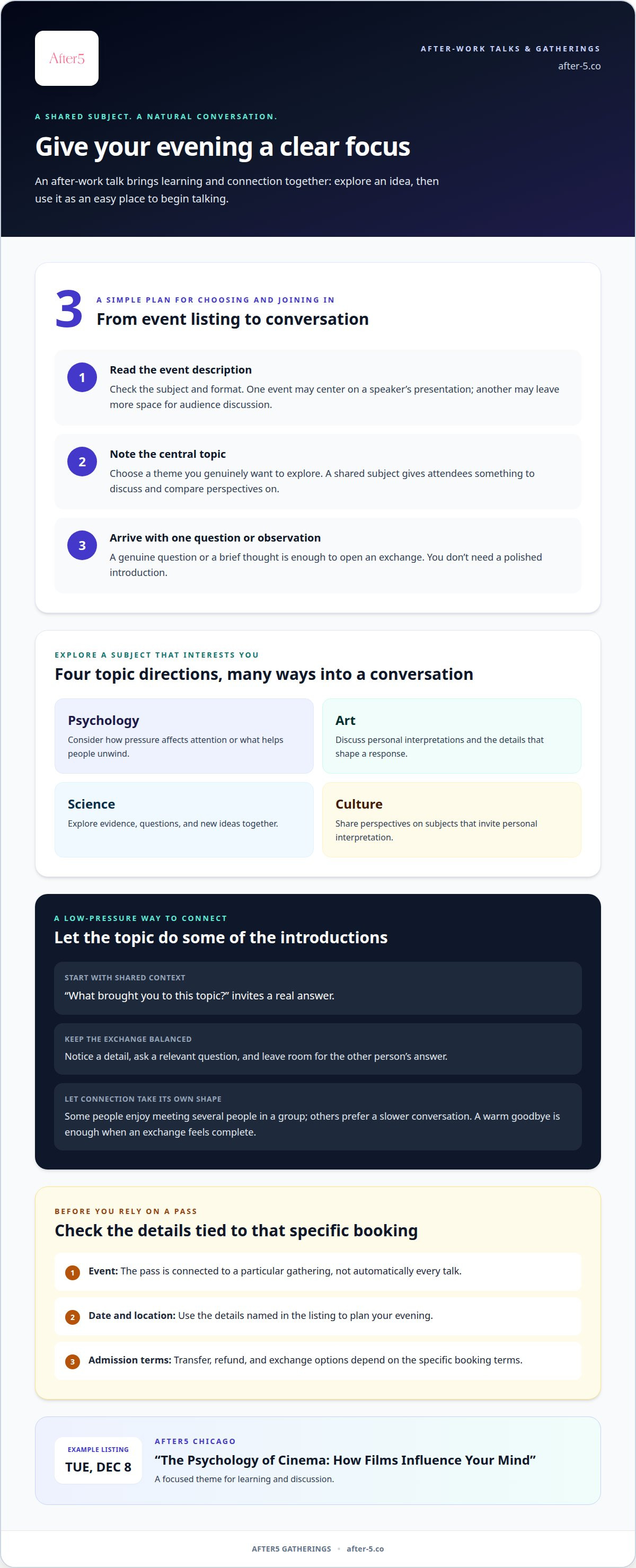
An after-work talk gives an evening a clear focus: a subject, speaker or presentation, and ideas to discuss afterward. Learning events can make topics such as psychology, art, science or culture easier to explore in a relaxed setting. The value is not only the information. A shared subject gives people an easy place to begin a conversation.
Think of a talk about stress. One person might be curious about how pressure affects attention; another might want practical ways to unwind after work. The same subject can invite different perspectives without requiring anyone to arrive with specialist knowledge. That mix can make discussion feel open and human, rather than like a lecture with a single right answer.
A useful way to choose an event is to start with the topic, then consider the kind of evening you want. A science-focused talk may suit someone who enjoys evidence and new ideas. A conversation about art or culture may leave more room for personal interpretation. Either way, a specific theme gives attendees something to share as they get to know one another.
For a smoother evening, use a simple three-step plan: read the event description, note the central topic, and arrive ready with one question or observation. For example, at a talk about film, you could ask how a particular scene shaped your response. You don’t need a polished introduction. A genuine question can open a thoughtful exchange.
Using or transferring a pass depends on the terms attached to the specific event booking. Don’t assume that a pass can be transferred to another person or event.
Refund or exchange options also depend on the booking terms. The event’s subject doesn’t determine whether a refund or exchange is available.
The pass applies to the event and location named in your booking, not automatically to every talk or venue. For an Amsterdam gathering, use the location and event details shown in the listing to plan where to go.
These distinctions matter because “talk” can describe different experiences. One event may focus on a speaker’s presentation; another may leave more space for audience discussion. Read the event description to understand its subject and format, so you can choose an evening that matches your interests and energy.
Learning and connection can sit naturally side by side. A shared topic offers a starting point, while conversation lets people discover different viewpoints and common ground. Choose a subject you genuinely want to explore, and the evening has a clear purpose before the first introduction.
Each session offers a clear focus. For example, After5 Chicago’s “The Psychology of Cinema: How Films Influence Your Mind” is scheduled for TUE, DEC 8, offering a focused theme for discussion.
Social connection
Meeting people feels easier when there’s a shared reason to be in the same room. A gathering creates that starting point: a conversation about a subject, a familiar life transition, or a perspective that catches your attention. For example, someone who has recently moved may find it simpler to talk about discovering a city than to make an introduction from scratch. Shared context gives the first exchange somewhere to go.
Try a small opening question that invites a real answer. “What brought you to this topic?” gives someone more to respond to than “Do you come here often?” You can also share a brief thought first, such as what surprised you or what you’d like to learn. One genuine observation is enough to begin. The aim isn’t to impress a room; it’s to discover whether a conversation feels mutual.
Group conversations can take pressure off a one-to-one introduction. If two people are discussing a recent career change, you might ask what helped them adjust or share your own experience. Listen for common ground, then build on it with a follow-up. A simple sequence works well: notice a detail, ask a relevant question, and leave space for the other person’s answer. That keeps an exchange balanced rather than interview-like.
Connection also takes different shapes. One person may enjoy meeting several people in a lively group, while another prefers a slower conversation with someone who shares their current priorities. For example, a change in routine, a new city, or a shift in personal interests can shape what someone hopes to find. Let the conversation unfold without deciding too quickly what it must become. Curiosity is a useful first step.
Not every promising conversation needs an immediate next step. If you’d like to stay in touch, say so plainly and give the other person room to respond. If the moment feels complete, a warm goodbye is enough. Respecting that choice helps keep social time comfortable for both people. It also makes future gatherings feel more natural, whether you meet a familiar face again or start fresh with someone new.
For a more intentional path toward meaningful friendship, explore an intentional friendship experience. A gathering can be one part of a wider social life, alongside everyday conversations and connections that grow over time. Choose an event that genuinely interests you, arrive with one open question, and focus on the person in front of you. Shared interests, thoughtful listening, and an easy pace can turn an introduction into the beginning of something more.
What is an After5 gathering pass?
An After5 gathering pass refers to access connected with a particular gathering. The event listing gives that idea practical meaning: it identifies the occasion, its subject, and the details that distinguish one booking from another. Think of a pass as tied to a specific listing, rather than assuming the word describes unlimited access to every gathering.
To understand what a pass covers, read the event information as a set of separate details. Start with the event name, then look at the date, location and stated admission terms. For example, an Amsterdam discussion listing is separate from a listing for another event. Similar themes don’t make two gatherings interchangeable.
The name alone doesn’t explain every part of an event experience. A pass does not promise extras such as refreshments, reserved seating or access to other activities unless the event details say so. This distinction keeps expectations clear. Admission to a talk, for instance, is separate from an additional benefit mentioned in its listing.
A simple way to interpret the information is to match each detail with the same event:
- Event: identify the exact gathering named in the listing.
- When: note the date and start time shown for that event.
- Where: use the listed venue or location to distinguish it from another gathering.
- Coverage: separate stated admission from any extra feature described independently.
This approach also helps when comparing two events. A learning talk and a social gathering may both involve meeting in person, yet their subjects and formats can differ. Read each listing on its own terms, rather than treating one pass as general membership or assuming it applies across the events calendar.
For example, if one listing names an evening talk and another names a separate gathering, compare their dates and stated terms before deciding which fits your plans. The event title tells you what the occasion is about; the remaining details clarify the specific booking. That gives you a grounded understanding of the pass without assuming every event includes the same things.
In short, an After5 gathering pass is best understood through the particular event it names and the admission details attached to that event. The listing is the practical guide to its scope. Read the event, timing, location, and coverage together, and you can make a clear choice based on the gathering you actually want to attend.
Concrete listings show why the details matter. After5NYC’s “Let's Talk About Death: What Ancient Burials Can Teach Us” event is scheduled for Dec 2 at Flop House Comedy Club and starts at 6:30. After5NYC’s “The Science of Stress: What Happens to your Brain Under Pressure?” event is scheduled for Dec 3 at Broadway Comedy Club. Their subjects, dates, and venues help identify the specific gathering each pass concerns.
The same care applies to other listings: After5Dallas's “The Disappearing Mind: What Alzheimer’s Does to the Brain” is scheduled for WED, DEC 9, 2026, at 6:30 PM in Dallas. After5NYC's “What Are They Hiding? The History of American Conspiracies” is scheduled for THU, DEC 10, 2026, at 6:30 PM in New York, while “The Science of Sound: What Your Voice Reveals About Who You Are” is scheduled for MON, DEC 14, 2026, at 6:30 PM in New York. Check those details against the pass you are considering.
What are the dates and hours covered by the pass?
The date and start time are tied to the specific gathering you select. Read those details together with the event title and location. An Amsterdam evening listing, for example, is the reference point for planning that outing. Don’t treat a pass as covering every date on the events calendar unless its terms say so. The event-specific schedule makes your plans concrete.
Start by matching the date to your calendar. Then compare the listed start time with your commute, workday and other plans. If a talk begins after work, consider how long it takes to reach the venue from where you usually finish your day. That practical step helps you decide whether the scheduled event fits, rather than relying on a broad idea of “after work.”
A start time is not the same as an event’s full duration. A listing that gives an evening start tells you when the gathering begins, but doesn’t by itself establish when it ends. Avoid planning around an assumed length. Use the stated schedule to decide whether you can attend, and leave flexibility around the event if your evening commitments matter.
Dates also distinguish one gathering from another. Two events may share a theme, yet take place on separate evenings or at different locations. Match the event name, date and venue before making travel plans. This simple check helps prevent a calendar mix-up, especially when you’re comparing several listings or saving more than one possible evening.
- Event: match the pass to the gathering named in its booking details.
- Date: use the date attached to that event, not another listing.
- Start: plan around the stated start time and your journey to the venue.
- Duration: don’t infer an end time from the start time alone.
For an Amsterdam plan, put the event date and start time into your calendar as separate details. Add the venue as the destination, then allow for your own travel arrangements. If you’re choosing between two evenings, compare those details side by side. A convenient date may matter as much as the subject, especially when work or personal plans already shape your week.
The useful takeaway is simple: the pass relates to a scheduled gathering, while its date and hours depend on that event’s details. Read the date, start time and location as one set. That gives you a clear basis for planning your evening without assuming one booking covers other dates, locations or event times.
Are there age or ID requirements for an After5 gathering pass?
The words “gathering pass” alone don’t establish an age threshold or an identification rule. Those details relate to the specific event’s entry terms. For an Amsterdam gathering, distinguish the event’s admission conditions from the pass name itself. That keeps a general label from being mistaken for a promise about who may attend or which document to bring.
Age requirements and identification checks are separate questions. An event may state an age condition without requiring an identity document for entry, or list an ID requirement for another reason. Don’t treat one as proof of the other. For example, a stated age limit doesn’t tell you which document, if any, the venue accepts.
Read the event information for direct wording about age, entry and identification. Look for a minimum age, a phrase requiring ID, or instructions connecting a document to the booking. Don’t infer an age or ID condition from the pass name or assumptions about other venues. The specific admission terms are the useful reference.
It also helps to separate ticket validation from age verification. A booking confirmation can identify the event and admission, while an identity document, if required, serves a different purpose. The event’s terms need to explain which applies. A confirmation showing the right event and date doesn’t automatically mean photo ID is required.
- Age: look for an explicit age condition attached to the event.
- Identification: distinguish a stated document requirement from a booking confirmation.
- Scope: apply the terms to the event named, not to every gathering.
- Wording: use the stated entry conditions rather than assumptions about venue customs.
These details matter when planning with a friend, too. If one person reads an age condition and another notices an ID instruction, compare both against the same event’s terms. A rule from a different venue or event may not describe the gathering you plan to attend. Keep the event name and its admission information together when discussing arrangements.
The practical answer is that the pass label itself doesn’t supply a universal age or ID rule. The event’s entry conditions determine what applies. Read those terms before making plans, and separate age eligibility, document requirements, and proof of booking. If your wider aim is to build meaningful friendships, explore a more intentional path to connection.
After5: Gatherings
After5 brings women together through Gatherings designed to make meaningful connection feel more natural. If you’re looking beyond a single evening and want friendship to grow through shared experiences, Gatherings offer a place to begin.
After5 Membership, Circles, and Alike provide other ways to build connection, including curated small groups and personalized introductions. Each offers a different starting point, whether you prefer meeting through a gathering or discovering people with similar interests and values.
Choose the format that feels comfortable for your current chapter. A gathering can create an easy first conversation; a Circle or personalized introduction can support a more focused way to meet. Contact After5 to explore which option may suit you.
Make your next gathering feel intentional
Choosing an evening is a small decision, but it can open space for fresh ideas and meaningful conversation. Let your interests guide you. The right gathering is one that feels worthwhile before you arrive and gives you a natural starting point with the people around you.
If you’re considering an After5 gathering pass, think about the kind of connection you’d like to make and whether this experience fits how you want to meet people. There’s no need to force a big outcome from one evening. One thoughtful conversation can be a good beginning.
Contact After5 about the pass to explore whether an After5 gathering pass feels like the right starting point. A new connection can begin with simply showing up, staying curious, and letting the conversation unfold.
Frequently Asked Questions
Where can I buy an After5 gathering pass?
Book through the After5 event listing for the specific Amsterdam gathering you want to attend. Select the event and review its booking details before completing your reservation. Some gatherings require an active membership, so a standalone pass isn’t available for every event. If you already have a membership, check whether that gathering is eligible for member access before booking a separate pass.
What does a gathering pass cost?
Some gatherings require an active subscription, while eligible subscriber gatherings may be included in membership access. The relevant option depends on the event and your membership status. Review the Amsterdam event’s booking details to see which applies. Confirmed gathering bookings are generally non-refundable.
What does the pass include?
An After5 gathering pass provides admission to the specific gathering named in its booking, rather than blanket access to every event. Gatherings are small-group meetups intended to help women connect face-to-face. Food and drinks aren’t included unless the individual event description says they are, so plan separately for any orders. Eligible subscriber gatherings may be included through membership, subject to the stated monthly limit.
Which locations or events accept the After5 gathering pass?
The pass applies to the specific gathering named in your booking, at the location shown in its event details. It does not automatically cover other events or locations.