


What if a new friendship doesn’t begin with instant chemistry, but with seeing the same woman again in a relaxed setting? Finding female friends in your 50s can feel different from making friends earlier in life. Existing friendships may have shifted, and advice aimed at younger adults may not fit your priorities now.
If starting a conversation or suggesting another meet-up feels awkward, you’re not alone. Building a warm, reciprocal social life takes time, and you don’t have to force a connection after one meeting. Shared interests, compatible life chapters, and regular, low-pressure contact can give friendship room to grow.
This guide offers realistic ways to meet women, find common ground, and take the next small step without putting pressure on yourself or anyone else. You’ll explore options in Amsterdam, from interest-led groups to curated communities, along with conversation starters and simple ways to follow up. Think less instant best-friend energy, more familiar faces, easy conversation, and the possibility of something meaningful taking shape.
Key Takeaways
- Changing routines and priorities can reshape your social world; wanting new friendships is a natural part of life, not a personal failing.
- For finding female friends in your 50s, start with what matters to you, then look for recurring spaces where shared outlooks can emerge.
- Compare community activities, interest-led groups, personal introductions, and small-group settings to find a rhythm that feels comfortable.
- Build on a promising first conversation with a warm follow-up and a simple invitation, then give trust time to grow.
- After5 Membership offers curated Circles, personalized Alike introductions, and monthly Gatherings as intentional ways to connect with women.
Why finding female friends in your 50s can feel different
Wanting new friendships is a meaningful need, not a sign that you’ve failed to hold on to the people who matter. Social worlds change as we do. The friendships that suited one chapter may not meet every need in the next, and making room for new connections can be a hopeful choice rather than a rejection of old bonds.
The concept of friendship spans many kinds of closeness, from familiar companionship to deep, trusted connection. There’s no single timeline or model to follow. A promising friendship doesn’t need to become intimate straight away. It can begin with a good conversation, then grow at a pace that feels comfortable to both of you.
Low-pressure friendship-building means creating regular chances to connect, without expecting each meeting to prove you’re meant to be close. Familiarity can make conversation easier. It also gives both people time to discover shared interests and see whether they enjoy each other’s company.
What changes in your social life during your 50s?
Work may become more demanding or take a different shape. Caregiving, a move, a change in family routines, or simply a new way of spending your time can make spontaneous catch-ups less common. Even close friends can be harder to see regularly when schedules no longer line up. The friendship may still matter deeply, while your everyday social needs shift.
There’s no single version of life at 50. Some women have full calendars; others are starting over in a new city or enjoying more time to themselves. Your interests, responsibilities, and availability are yours. A new friendship can begin at any age or life stage, sometimes through a small moment of connection that grows over time.
Why can starting a friendship feel awkward?
It can be hard to tell whether someone is open to making a new friend, especially when you’ve only spoken briefly. A simple question or conversation starter is an invitation, not a demand for instant closeness. You might ask how she got interested in a shared activity or mention that you’ve enjoyed chatting. Keep it easy, then let her response guide what happens next.
Comfort often comes from seeing someone more than once, not from delivering a perfect first impression. Give yourself time to notice how you feel around her and whether she also makes an effort to continue the conversation. Mutual interest can show up in small ways: a warm reply, a question in return, or a suggestion to meet again. You don’t need to decide immediately whether this is a lasting friendship. Stay open, stay observant, and let the connection reveal itself.
How to find women in your 50s who share your outlook
Finding female friends in your 50s becomes more approachable when you treat it as a series of small choices, not a search for someone whose life story matches yours exactly. Start with what you value, find a setting you can return to, and give conversation room to unfold. Shared outlook matters more than identical biographies.
Start with the kind of friendship you want
Take a moment to name what feels important in a friendship now. Perhaps you’re drawn to warmth, curiosity, humour, reliability, or conversations that go beyond small talk. Then consider what fits your current routines and energy. Would you enjoy an occasional coffee and thoughtful catch-up, or a more regular connection woven into the month?
Use those preferences as a compass, not a checklist. A woman may have a different career, family situation, or background and still share your values and conversational rhythm. Notice how you feel around her. Is there room for both of you to speak? Does she show interest in your perspective? Those signals can matter more than having the same hobbies or history.
Choose places where conversation can happen more than once
Look for a recurring setting connected to something you already enjoy or want more of in your life. A regular community activity, an interest-led group, or a small gathering can make it easier to recognize familiar faces and pick up a conversation naturally. In Amsterdam, choose an option that feels accessible and suits your interests, energy, and schedule. Consider the journey as well as the activity: a group you can comfortably get to is easier to return to.
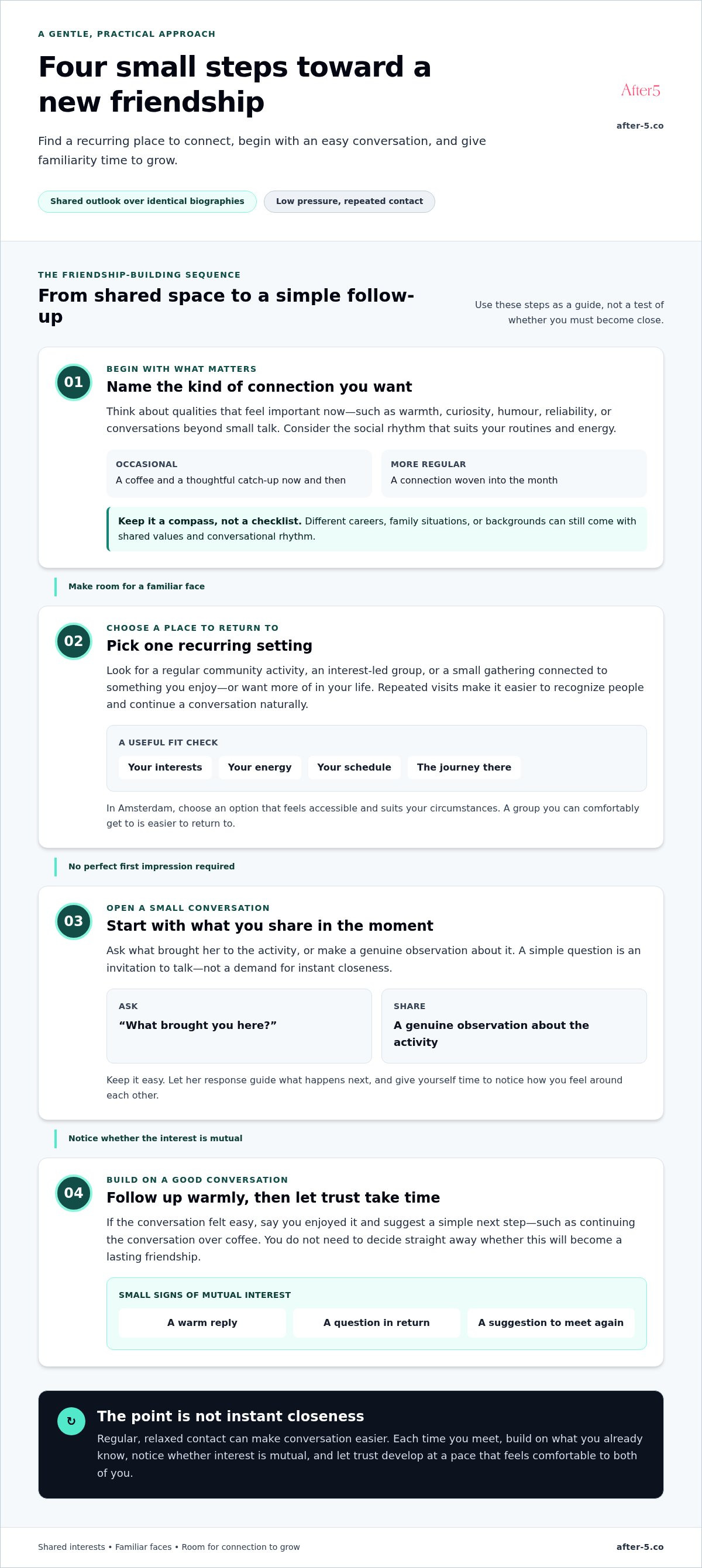
Try this simple sequence:
- Identify what matters. Choose a few qualities you hope to find, along with the kind of social rhythm you can sustain.
- Pick one recurring setting. Give yourself a chance to become familiar with the people and atmosphere before deciding whether it fits.
- Start small. Ask someone what brought her there, or share a genuine observation about the activity.
- Follow up warmly. If the conversation felt easy, say you enjoyed it and suggest a simple next step, such as continuing the conversation over coffee.
Repeated, relaxed contact takes some pressure off the first meeting. You don’t have to create instant closeness or carry the entire conversation. Each time you meet, you can build on what you already know, notice whether interest is mutual, and let trust develop at a comfortable pace.
If you’re reflecting on what helps women feel connected, this guide to a female circle and meaningful connection offers another perspective. For a more intentional structure built around shared interests and life chapters, explore After5 Membership and its friendship opportunities.
Where to meet friends in Amsterdam and how to choose
In Amsterdam, you can widen your social circle through community activities, interest-led groups, personal introductions, and curated small-group gatherings. The right fit depends on how you like to connect, how much structure you prefer, and what you can comfortably make time for. For finding female friends in your 50s, look for a setting that makes it possible to meet again, not just one that sounds appealing on paper.
Setting | Repeat contact | Conversation structure | Scheduling flexibility
Recurring community activities | Often, if you attend regularly | The shared activity gives conversation an easy starting point | Depends on the group’s schedule
Interest-led groups | Varies by how often the group meets | A common interest offers an immediate topic | Depends on the group and its schedule
Personal introductions | Depends on whether you arrange another meeting | Often more focused, with one person to get to know | You can suggest a time that suits both of you
Curated small groups | Can offer repeated connection when gatherings recur | A smaller setting can make it easier to join the conversation | Depends on the group’s format
Which setting fits your personality and schedule?
If you prefer quieter conversation, a small, structured setting may feel more comfortable than entering a large group alone. If you enjoy meeting different people, a recurring community activity can create more chances to connect. Group size shapes the feel of a first conversation; regularity shapes whether familiar faces become easier to approach. Think about travel time, energy, and calendar space, too. Choose something you’d enjoy even if friendship takes time to develop.
If you’re new to Amsterdam, a women’s community may offer a shared starting point. An interest-led group can suit you if you’d rather connect through a topic you already enjoy. Personal introductions and curated small groups provide more structure for meeting someone new. Each route has a different rhythm, so there’s no need to choose the most social-looking option. Choose what feels sustainable.
How do you make the first conversation feel natural?
Let the setting do some of the work. Try, “What brought you here?” or “Have you been part of this group for long?” Listen for something you genuinely have in common, then ask one thoughtful follow-up. If she mentions enjoying a particular kind of outing, for example, you might ask what she likes about it. Keep the exchange light. It’s a conversation, not a test of lifelong compatibility.
As you compare options, consider what makes a women’s community feel like a good fit, including its size, shared outlook, and style of connection. This guide to choosing a women’s micro-community can help you think through those preferences. After5 Membership brings Circles, Alike introductions, and Gatherings together around friendship. Explore After5 Membership.
How to turn a promising introduction into a real friendship
A lovely first conversation is a beginning, not a verdict. Trust and ease usually grow through several interactions, as you learn how the other person listens, shares, and follows through. There’s no need to make one meeting carry the weight of a whole friendship. Let the next step be small and sincere.
What should you do after a good first conversation?
Reach out while the conversation is still fresh. Mention something specific you enjoyed, then suggest an easy way to meet again. For example: “I enjoyed hearing about your garden. Would you like to continue our conversation over coffee sometime?” A clear, low-key invitation is kind and easy to respond to.
Keep the follow-up simple:
- Express interest. Say you enjoyed meeting or talking with her.
- Suggest a next step. Offer a relaxed plan that suits both your routines, such as a walk or coffee.
- Stay open and consistent. If she’s busy, give her room to reply or suggest another time. Notice whether she helps keep the connection moving.
Making the first invitation doesn’t mean you’re signing up to carry the friendship. It’s an opening, not an obligation. Plans can take time to align, so avoid reading too much into one delay. At the same time, pay attention to whether she responds warmly, proposes another option, or reaches out later. Let the pattern, not a single moment, guide you.
How can you build consistency without overcommitting?
Choose contact that feels natural for your life. A brief message about something you discussed, a check-in after a shared activity, or an occasional invitation can keep the connection warm without turning friendship into another task. You don’t need to message constantly. Respect your own boundaries and hers, and let the pace take shape together.
Shared activities can also make it easier to spend time together without searching for a fresh topic every time. You might return to a regular group, continue an interest you’ve talked about, or plan a simple outing connected to something you both enjoy. The activity gives you something to experience side by side, and conversation can deepen along the way.
Healthy new friendships make room for both people to reach out. That reciprocity doesn’t have to look perfectly equal at every moment. Look for a general sense of mutual care: both of you show curiosity, make space, and contribute to staying in touch. In finding female friends in your 50s, patience matters, but so does choosing connections that feel warm and balanced.
After5 Membership brings together Circles, personalized Alike introductions, and small-group Gatherings for women looking to build genuine friendships. Explore After5 Membership.
A more intentional way to find female friends in your 50s
Sometimes the hardest part isn’t knowing that you’d like more connection. It’s finding a comfortable way to meet women you might genuinely enjoy. A little structure can make that first step feel more natural. It creates shared ground and opportunities to meet again, without asking you to force instant closeness. The aim is a promising opening, then space for a friendship to develop through real conversation and time together.
How can curated introductions make meeting people easier?
A personalized introduction gives you a place to begin. With Alike, After5 introduces women based on compatibility and shared interests. That shared ground can make the opening conversation feel less like starting from scratch. You might talk about an interest you both enjoy or compare what you’re looking for in this chapter of life.
Compatibility can make a first meeting feel more considered, but it can’t decide the whole story. You’ll still learn about each other through conversation, follow-through, and time spent together. Think of an introduction as a starting point, not a promise that you’ll become close. Let your own experience tell you whether the connection feels comfortable and mutual.
What can recurring Circles and Gatherings offer?
Circles are curated communities shaped around life phases, lifestyles, and shared perspectives. They can suit you if you value a common context and the chance to meet women whose outlook resonates with yours. You don’t need identical circumstances to find common ground. A shared perspective can be enough to begin.
Gatherings bring women together in intimate small-group settings for face-to-face conversation. After5 Membership includes monthly gatherings, creating recurring opportunities to connect. Regular chances to meet can make it easier to recognize familiar faces and continue a conversation, but they can’t guarantee friendship. Each relationship still unfolds between the people involved.
Consider what kind of support would feel most useful right now:
- Choose Alike if a personalized introduction and shared interests would make the first step easier.
- Explore Circles if connecting around a life phase, lifestyle, or perspective appeals to you.
- Consider Gatherings if you’d enjoy meeting women through small-group, in-person conversation.
These options bring intention to finding female friends in your 50s, while leaving the pace and possibility of each connection in your hands. After5 Membership combines friendship matching, Circles, and monthly Gatherings for women seeking meaningful connections.
Make room for the next meaningful connection
Friendship doesn’t need a grand beginning. It can start with one choice that feels manageable: showing up, sharing a little more, or making space in your week for someone new. Let curiosity lead, and allow connection to take its own shape. You’re not behind, and you don’t have to know where a first conversation will lead.
Finding female friends in your 50s can be less about changing who you are and more about creating openings for the people who appreciate who you’ve become. A thoughtful community can make those openings easier to find, while leaving you free to decide which connections feel right.
After5 Membership offers personalized friendship introductions, curated Circles, and monthly small-group Gatherings for women looking to meet and connect. Explore After5 Membership to find a friendship-focused way to meet women in Amsterdam.
Frequently Asked Questions
Is it too late to make new female friends in your 50s?
No, it’s not too late. Friendship has no age limit, and a new connection can begin during any chapter of life. Start with an activity or community that already interests you, so meeting people feels connected to something you enjoy. For example, choose a recurring group that fits your week, then give yourself permission to attend a few times before deciding whether you feel at home there.
How do I meet new friends in my 50s if I am shy?
Choose a setting where you can focus on a shared activity rather than making conversation the whole point. Before you go, think of one easy question, such as, “What do you enjoy most about this?” You don’t need to introduce yourself to everyone. A brief exchange with one person is a real beginning, and you can build confidence by returning to a setting that feels comfortable.
Can you make close friends in your 50s?
Yes, close friendships can grow in your 50s and beyond. Closeness often develops through ordinary moments: remembering what someone shared, checking in after a challenging week, or laughing about something you experienced together. Notice whether you feel respected and able to be yourself. You don’t need instant chemistry to see potential; steady kindness and genuine curiosity can make a connection feel safer with time.
How long does it take to make a new friend in your 50s?
There’s no set timeline. One person may feel comfortable opening up quickly, while another prefers to build trust gradually. Instead of measuring progress by weeks or meetings, notice whether you’re learning more about each other and enjoying the contact. Keep invitations easy to accept or decline, and leave room for busy schedules. A slower pace can still lead to a close, lasting friendship.
What should I do if I feel awkward reaching out after meeting someone?
Send a short message that refers to a detail from your conversation, such as, “I enjoyed hearing about your ceramics class. I’d love to hear more sometime.” If it feels right, add a simple invitation. You’re offering a possibility, not asking for a commitment. If she doesn’t respond or suggest another time, let that inform your next step without treating it as a judgment of your worth.
Where can women in their 50s meet new friends in Amsterdam?
In Amsterdam, consider recurring community groups, interest-led activities, or women-focused friendship communities. Think about what makes attending realistic: travel time, the day of the week, and whether you prefer a quieter group or a more active setting. Choose somewhere you’d value going even if you don’t meet a close friend immediately. After5 also offers curated Circles, personalized introductions, and small-group Gatherings designed to help women connect.
How do I know whether a new friendship is becoming one-sided?
Look for the overall pattern rather than counting messages or invitations. Does she sometimes ask about your life, respond with care, or make an effort to find another time when she’s unavailable? Reciprocity can look different for each person, especially during a busy period. If you’re consistently the only one reaching out, pause and leave space. Her response can help you decide how much energy to invest.
Ready to meet women in Amsterdam through personalized introductions, curated Circles, and small-group Gatherings? Explore After5 Membership.