


What if the smallest things you do for a friend are the ones that make them feel most remembered? If you’ve wondered how do small gestures strengthen friendships, the answer isn’t grand gestures or perfectly timed plans. It’s the steady signal that says, “I’m thinking of you.”
A quick check-in, a remembered detail, or your full attention during a conversation can mean a lot. But when life gets busy, it’s easy to let those moments slip. And if a friendship feels distant or one-sided, reaching out can start to feel awkward or forced.
Small acts of care work best when they’re genuine, simple, and shared over time. This article explains what everyday gestures communicate, how to show care without adding pressure, and how repeated opportunities to connect can help new friendships grow. Little by little, attention becomes trust, and friendship has room to develop.
Key Takeaways
- Understand how do small gestures strengthen friendships: their impact comes from attention, consistency, and what feels meaningful to the person receiving them.
- Choose gestures that communicate remembrance, encouragement, practical care, or shared joy, while keeping your friend’s preferences in mind.
- Make care feel natural by noticing, personalizing, offering, and leaving room for your friend to respond.
- Match your gestures to your time, energy, and the stage of the friendship, rather than making promises you can’t sustain.
- Let new connections deepen through repeated, comfortable chances to talk and follow up, without rushing closeness.
How small gestures strengthen friendships: the meaning behind everyday care
A small gesture is a modest, relationship-aware action that communicates attention or care. It might be a message before a big day, an offer to help with a practical task, or a moment of genuine focus when you’re together. The action itself can be simple. Its meaning comes from whether it reflects what you know about your friend and what’s happening in their life.
So, how do small gestures strengthen friendships? They make care visible in ordinary moments. The meaning depends on the person receiving the gesture, the context, and whether your actions feel sincere over time. A friend who prefers quiet support may appreciate a low-key offer to help more than a public celebration. Another may feel seen when you remember a detail they shared weeks ago. The concept of friendship includes different kinds of bonds, a reminder that there’s no single gesture or rhythm that suits everyone.
Small gestures can nurture trust, but they can’t do all the work of a friendship. They don’t replace honest conversation, respect for boundaries, or shared effort. If something feels strained, a kind message may open the door, but listening and speaking plainly still matter. Everyday gestures make care visible, one thoughtful moment at a time.
Why being remembered can make a friend feel valued
Remembering a detail shows that you were present when your friend shared it. A brief “How did the appointment go?” or “Have things eased up with that challenge at work?” connects today’s conversation to what mattered to them before. It says their experience didn’t disappear from your mind as soon as the conversation ended.
That personal relevance often matters more than spending money or creating a spectacle. Keep the follow-up gentle, too. If your friend doesn’t want to discuss it, let them change the subject. Attention feels caring when it leaves room for choice.
How consistency builds a sense of reliability
Occasional, sincere contact can keep a friendship present between meetups. You might pick up a conversation after a busy stretch, share a note when something reminds you of your friend, or follow through on a plan you made together. These actions help make your care tangible, not just something you say you feel.
Consistency isn’t constant availability. Friends don’t need to reply immediately or keep the same texting rhythm through every season of life. Work, family, health, and transitions can change how often people connect. Aim for a pace that feels warm and sustainable for both of you, then be honest when your capacity shifts. Reliability grows through care and follow-through, not pressure to always be reachable.
Everyday friendship gestures that create warmth and connection
If you’re wondering how do small gestures strengthen friendships, start with the message beneath the action. A friend may feel remembered, encouraged, supported, or simply invited into a moment of joy. The best gesture isn’t necessarily a gift or a long conversation. It’s one that fits the person and the relationship.
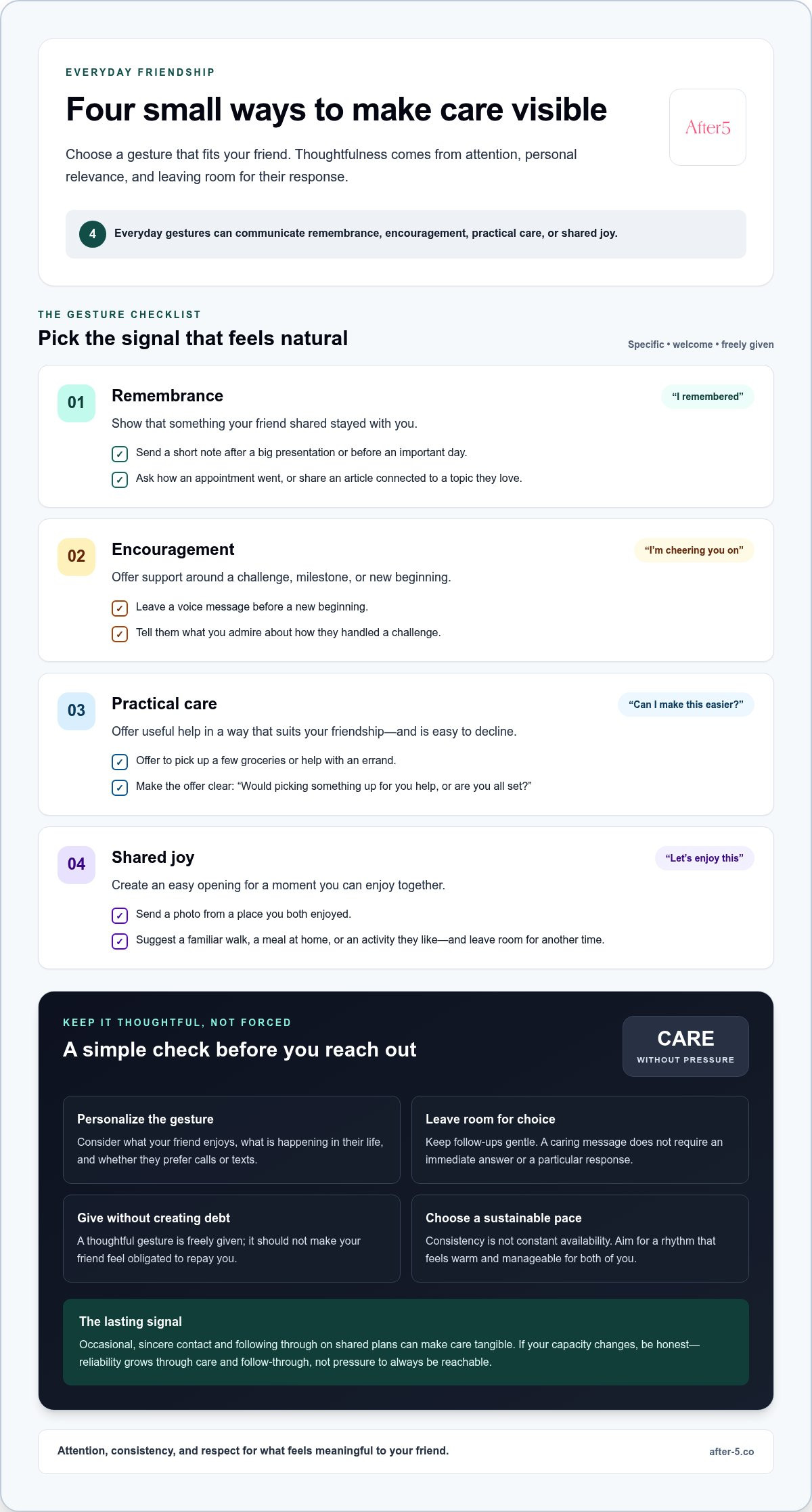
A thoughtful gesture is specific, welcome, and freely given. It doesn’t create a debt or demand a particular response. Keep these four signals in mind, and choose the one that feels natural for your friend:
- Remembrance: Send a short note after a big presentation, or share an article connected to a topic your friend loves.
- Encouragement: Leave a voice message before a new beginning, or tell them what you admire about how they handled a challenge.
- Practical care: Offer to pick up a few groceries or help with an errand, but only if this kind of support suits your friendship.
- Shared joy: Send a photo from a place you both enjoyed, or invite them to a walk, a meal at home, or an activity you know they like.
Small ways to show you remember and pay attention
A thoughtful follow-up can be brief and open-ended: “I remembered your interview was this week. No need to reply now, just wanted you to know I’m cheering you on.” That shows care without asking your friend to report back. You could also pass along a book recommendation, recipe, or article because it connects to something they’ve told you they enjoy.
Personalize the channel, too. If your friend prefers calls to texts, suggest a quick conversation. If they like time to respond, send a note that doesn’t require an immediate answer. Consideration is often less about saying more and more about choosing a way of reaching out that feels comfortable to them.
Simple gestures of encouragement, help, and shared joy
Celebrate in a way that suits your friend. A warm message about a milestone may feel more personal than a public post; a small homemade treat may be welcome, while someone else might prefer a sincere conversation. When offering help, be clear and easy to decline: “I’m heading to the store. Would picking something up for you help, or are you all set?”
Invitations can carry the same ease. Suggest a familiar walk, a shared lunch, or trying a recipe together, then leave room for a no: “I’d love to catch up, but another time is completely fine.” That keeps connection open without turning it into an obligation.
There’s no need to make every gesture elaborate. Choose something that fits your friend, your relationship, and the energy you genuinely have to give. For women looking to make space for recurring connection, After5 Membership offers curated Circles, personalized introductions, and monthly small-group gatherings where connections can develop through shared experiences.
What makes a small gesture feel thoughtful rather than forced?
A gesture feels thoughtful when it reflects the person receiving it, not a script for how friendship is supposed to look. A grand surprise may delight one friend and overwhelm another. A heartfelt note may feel intimate to someone who values words, while a practical offer or quiet presence may land better with someone else. The question isn’t whether the gesture looks impressive. It’s whether it feels welcome and true to your relationship.
That’s part of how do small gestures strengthen friendships: they show care while respecting the other person’s preferences and freedom. A gift or favor shouldn’t carry an unspoken bill. If you’re hoping it will secure closeness, prompt a particular response, or obligate your friend to return the favor, it may feel more like pressure than kindness. Give because you want to offer care, not because you expect access, gratitude, or a matching gesture.
Personalization, timing, and boundaries matter
Consider the difference between one gentle check-in after a difficult week and repeated messages asking for an update after your friend has said they need space. The first recognizes their experience; the second may disregard what they’ve told you. Likewise, offering to help with a task can be generous, but accepting “No, thanks” without persuasion is part of the care.
Preferences aren’t always obvious, and they can change. Notice whether your friend seems comfortable, responds warmly, or redirects the conversation. If you’re unsure, ask with curiosity rather than assuming your way is universal: “Would a call or a text feel better?” Communication habits and expectations differ across people, families, and cultures. One style isn’t the measure of how much someone cares.
How mutuality differs from keeping score
Mutual care doesn’t mean matching every gesture, message, or favor. One friend may plan meetups while another offers thoughtful listening; support can take different forms and arrive at different times. During a demanding season, a friend may have less energy to initiate or respond. A temporary imbalance doesn’t automatically mean the relationship has stopped mattering.
Look at the broader pattern instead of tallying each exchange. Is there interest, respect, and some willingness to show up when life allows? Or do you regularly feel responsible for keeping the friendship alive, even after you’ve expressed what you need? A persistent imbalance deserves attention, but it’s best explored with a conversation, not a silent test.
Try naming your experience without accusing: “I miss spending time together, and I’ve noticed I’m usually the one making plans. Could we talk about what feels realistic for both of us?” Then listen. Your friend may share context you didn’t know, or you may learn that your expectations differ. Honest conversation creates room to adjust, set boundaries, and decide what kind of effort feels sustainable.
Thoughtfulness is a practice of paying attention, staying flexible, and letting care remain freely given. Make the gesture fit the friendship, then let your friend meet it in their own way.
How to make small gestures part of a friendship without pressure
The question “how do small gestures strengthen friendships” has a practical answer: let attention guide the action, then keep it flexible. You don’t need a schedule of check-ins or a running list of favors. Start with what your friend has actually shared, choose something that fits your capacity, and leave them room to respond in their own time.
Think of it as a light-touch practice, not a friendship productivity plan. Some weeks you’ll have energy to reach out. Other weeks, life may be full. A gesture is meaningful when it feels sincere and appropriate to the relationship, not when you hit a quota.
A simple four-step way to choose a gesture
Use this sequence when you’d like to show care but aren’t sure what would feel right:
- Notice: Start with something your friend has mentioned, such as a change at work or a busy period. Avoid guessing what they need based on what you would want.
- Personalize: Pick one proportionate action that fits the detail they shared. If they’re preparing for a demanding week, you might offer a short call or send a note of encouragement.
- Offer: Make it clear and easy to decline: “I have time to listen this week if that would help. No pressure if you’d rather have a quiet evening.”
- Give space: Let your friend respond when they can. If they decline, accept it warmly. If they communicate differently from you, adapt rather than interpreting a slower reply as rejection.
The best choice is one you can offer freely. A brief, personal message may suit a busy day; an in-person gesture may fit a friend who prefers face-to-face time. Keep it within your real energy and the closeness you already share. You don’t need to make a dramatic offer to prove you care.
What to do when effort does not feel mutual
Pause before deciding what a pattern means. Stress, life changes, or different communication habits may affect how each of you stays in touch. Look at the wider relationship, not one unanswered message. If you still feel hurt, say so kindly and describe a specific change you’d welcome: “I miss our conversations. Could we take turns suggesting a time to catch up?”
Then notice whether a conversation leads to more understanding or a realistic adjustment. Mutuality doesn’t require identical effort at every moment, but your needs matter too. You can care about a friend and still protect your time, energy, and boundaries. Thoughtful gestures should make connection more possible, not leave you depleted.
If you’re ready for recurring opportunities to connect, explore After5 Membership to meet women through curated Circles, personalized introductions, and monthly small-group gatherings.
Growing new friendships through small, repeated moments of care
New friendships rarely need to begin with a grand reveal or instant sense of closeness. Often, they take shape through comfortable chances to meet again, share a little more, and remember what the other person said. If you’ve asked, “how do small gestures strengthen friendships?” one answer is that small signs of interest can make it easier to continue a promising connection without rushing it.
Gentle initiative might mean returning to a group, following up after an enjoyable conversation, or asking a thoughtful question the next time you meet. It doesn’t mean pushing for private disclosures, constant contact, or an immediate label for the relationship. Let curiosity lead. Listen, share at a pace that feels comfortable, and notice whether the other person seems open to more conversation.
Let familiarity grow through shared moments
Seeing the same people in a welcoming group can make the next conversation feel less like starting from scratch. You may recognize a face, recall a detail, or have a shared moment to pick up. Familiarity builds gradually, giving both people a chance to discover whether they enjoy each other’s company without pressure to become close on the spot.
After a good conversation, a simple follow-up can keep the door open: mention something you enjoyed discussing or ask how a project they brought up is going. Then give the connection space. A warm response may invite another exchange; a brief reply or no follow-up may simply mean the timing isn’t right. Stay open without deciding what the relationship must become.
Find welcoming spaces for new connections in Amsterdam
For women in Amsterdam looking to meet others in a similar life phase or with shared interests, a setting designed for friendship can make repeated connection feel more natural. After5 is a friendship platform for women, with curated Circles, personalized introductions based on compatibility and shared interests, and monthly small-group gatherings designed for face-to-face connection.
Each format creates a different opening. A Circle brings women together around shared perspectives; a personalized introduction offers a starting point for a one-to-one conversation; and a small-group gathering gives people space to talk in person. None requires instant intimacy. They create opportunities to meet, see what feels comfortable, and let mutual interest guide what happens next.
Recurring opportunities can help when busy routines make it hard to create connection from scratch each time. A familiar setting offers a simple reason to reconnect and a chance for conversations to unfold at an unhurried pace. Friendship still develops person by person, through curiosity, respect, and shared effort. Explore After5 Membership.
Make room for the friendships you want to grow
You don’t have to wait for the perfect moment to create more connection. Start with a small, genuine step, then stay open to what grows from it. The answer to how do small gestures strengthen friendships isn’t about doing more. It’s about showing up with care in ways that feel right for both people.
If you’re ready to widen your circle in Amsterdam, choose a setting that makes meeting new people feel intentional and gives connections room to develop. Explore After5 Membership to connect with women through curated Circles, personalized introductions, and monthly gatherings.
One thoughtful step is enough to begin. Let it be yours, and let the next moment take shape naturally.
Frequently Asked Questions
How do small gestures strengthen friendships?
Small gestures strengthen friendships by showing that attention continues between major conversations and plans. A quick, relevant check-in can help a friend feel considered, especially during a stressful stretch or an important transition. Over time, these moments can build a sense of security: your friend knows they can share something meaningful without it being forgotten. They work best alongside honesty, respect, and the effort to understand each other.
What are examples of small gestures between friends?
Try sending a photo that recalls a private joke, saving a seat when you know your friend is joining a group, or returning something you borrowed with a note of appreciation. You could also offer to review a short presentation or help them think through a decision, if that kind of support is welcome. Choose an action that relates to your friend, rather than copying a gesture that worked for someone else.
Can small gestures make a friendship stronger even if you do not see each other often?
Yes. A friendship can stay meaningful across busy schedules or distance when both people make room for contact in ways that work for them. If you meet only occasionally, you might pick up a conversation where you left off, or mention a detail from your last visit so your friend knows it stayed with you. There’s no need to recreate daily closeness; focus on making the time you share attentive and genuine.
How often should you make small gestures for a friend?
There’s no universal schedule. Let the friendship, your friend’s preferences, and your available energy guide how often you reach out. A gesture might follow a meaningful conversation, a change in circumstances, or a moment that naturally brings your friend to mind. Avoid turning connection into a streak to maintain. If you’re unsure whether your rhythm suits both of you, talk about what kind of contact feels comfortable.
What if my friend does not reciprocate small gestures?
First, consider whether you and your friend show care in different ways. One person may initiate plans, while another offers support when you need it. If you’re feeling overlooked, identify what would help you feel more connected, then share that calmly. You can also scale back gestures that leave you resentful. A friendship should have room for both people’s needs, even if their contributions don’t look identical.
Can a small gesture feel forced or create pressure?
Yes, especially if it’s overly intimate for the relationship, ignores a stated preference, or seems to expect a favor or response in return. Before acting, ask yourself whether the gesture suits this friend and whether you’d still feel comfortable offering it if they didn’t react as hoped. If you’re uncertain, make the offer easy to decline. A warm, simple gesture should leave your friend free to respond in their own way.
Do small gestures help build new friendships?
They can help a new connection develop by making interest clear without demanding instant closeness. After meeting someone in Amsterdam, for example, you might follow up on a topic you both enjoyed discussing, then see whether they engage too. Let familiarity build through shared conversation and mutual curiosity. If the other person doesn’t respond or seems less interested, give them room. A promising friendship grows through welcome contact, not pressure.