


What if making a lasting friendship in your 30s has less to do with instant chemistry and more to do with showing up again? If you’re wondering how to make friends in your 30s, you may already know the tricky part: work, family, and familiar routines can leave few natural chances to meet new people. And even when you click with someone, starting a conversation or suggesting another meet-up can feel surprisingly awkward.
That doesn’t mean you’ve missed your moment. Adult friendships often grow through small, repeated interactions, not one perfect first meeting. A shared interest, a thoughtful follow-up, and another chance to spend time together can give trust room to take shape.
This guide offers a practical plan for finding compatible people, feeling more at ease initiating contact, and turning promising introductions into mutual friendships. You’ll learn how to choose settings you can return to, start conversations, and follow up without forcing closeness. In Amsterdam, After5’s curated Circles, personalized Alike introductions, and small-group Gatherings offer structured ways for women to meet. Start small, then let familiarity build.
Key Takeaways
- Learn why work, routines, and changing priorities can make adult friendship feel different, without making connection out of reach.
- See how shared time, genuine curiosity, and follow-through can help a new connection grow naturally.
- Explore ways to meet people through recurring activities, community groups, introductions, and small-group gatherings.
- Discover how to make friends in your 30s with a simple, low-pressure plan: choose a setting, start a conversation, follow up, and return.
- Find thoughtful ways to keep promising connections warm while letting friendship deepen at a pace that feels mutual.
Why making friends in your 30s can feel different, and why it is still possible
Work can fill the hours when you once met people naturally. Established routines, caregiving, relocation, or changing priorities can narrow your everyday social world, too. Your life may look completely different from someone else’s at the same age, but the feeling can be familiar: fewer unplanned conversations and fewer chances to see the same new faces again.
That shift can make friendship seem like it should happen instantly. It doesn’t have to. A useful way to think about how to make friends in your 30s is to create repeated opportunities for mutual connection, rather than expecting to meet a best friend in one conversation. Familiarity gives interest time to grow into trust. Repeated contact turns a passing hello into a familiar face, and a familiar face into someone you may want to know better.
What changes about friendship after your twenties?
School, campus life, or an early workplace can bring people together in the same place, week after week. Later, schedules may become more fragmented. One friend might be balancing a demanding job; another may have children, be caring for family, or be settling into a new city. Some people are exploring new interests, while others are content with familiar routines.
There’s no single 30s experience. The common change is that everyday proximity often takes more intention. Instead of relying on chance encounters, choose settings where you can return and let conversation unfold over time. That’s not a flaw in your social skills. It’s a different rhythm for meeting people.
Does everyone already have their people?
It can look that way from the outside. People have colleagues, old friends, or friendly acquaintances, but those connections don’t always offer the closeness, shared perspective, or regular companionship they want now. A full calendar doesn’t necessarily mean someone feels fully known.
Established friendships don’t automatically close the door to new ones. People’s needs and circumstances shift; a move, a new chapter, or a change in interests can make fresh connection feel welcome. Friendship can begin at any age, and it doesn’t need to compete with the relationships already in your life. The human pull toward social connection can remain meaningful through every stage.
If you’re starting from a small circle, or hoping to find women who feel more aligned with who you are today, you’re not behind. You’re creating room for connection to take shape. The next step is choosing where repeated, low-pressure encounters can happen.
How adult friendships grow: shared time, follow-through, and mutual interest
A good first conversation is a beginning, not a verdict. You might laugh easily over lunch or discover you both love exploring a new neighborhood. That spark matters, but trust forms as you learn how someone listens, what they care about, and whether spending time together feels comfortable more than once.
Familiar, low-pressure settings can help. A recurring group or regular activity offers fresh openings to talk without making every meeting feel like a big social test. Shared interests give you an easy starting point, while genuine curiosity lets the conversation move beyond the activity: What drew her to it? What else is she looking forward to? Advice on making friends as an adult also emphasizes being open to connection rather than waiting for perfect chemistry.
Why recurring contact matters more than instant chemistry
Seeing someone again gives both of you more chances to relax and be yourselves. A first meeting may be enjoyable but brief; later conversations can reveal humor, values, and the little details that build trust. Not every promising introduction needs to become a close friendship. Sometimes it stays a pleasant acquaintance, and that’s okay. Notice what feels promising and allow it to develop at a natural pace.
Make follow-through clear and easy to answer. Try: “I’ve enjoyed talking with you. Would you like to get coffee next week? I’m free Tuesday or Thursday, but no pressure if those don’t work.” A specific invitation shows interest without asking for a major commitment. If schedules don’t align, suggest another option once, then leave room for her to respond.
How to tell whether a new connection feels mutual
Look for a pattern, not a perfect script. She may ask thoughtful questions, build on something you shared, or seem engaged when you talk. Mutual interest might show up in her accepting an invitation, suggesting another time, or reaching out later. Communication styles vary, and a busy week or a quieter personality doesn’t automatically mean disinterest.
Reciprocity is a balance of interest, effort, and communication, not an exact exchange at every turn. You can initiate once or twice and still leave space for the other person to meet you halfway. If you’re exploring how to make friends in your 30s, After5’s Circles, Alike introductions, and small-group Gatherings offer structured ways for women to meet around shared perspectives and interests. Learn about After5 Membership for friendship connections.
Meeting friends in your 30s: How to find the right fit
The best place to meet new people isn’t necessarily the most exciting one. It’s a setting you genuinely enjoy and can return to, where conversation has room to become familiar. Classes, volunteering, community groups, and recurring social gatherings all create openings, but they offer different levels of structure. A class gives you a shared focus and natural conversation cues. An open community setting may feel more casual, while a small-group gathering can make it easier to hear and connect with a few people.
Consider the practical details, too. A nearby activity at a repeatable time may be more useful than an intriguing option across town that’s hard to fit into your week. Bryant University offers expert advice on building friendships, including the value of making space for connection as social circles change. Start with one manageable choice.
Which settings make it easier to meet people more than once?
Look for formats that bring people together around a shared interest or purpose. A class or volunteering can make the first conversation easier because you already have something to talk about. A community group may offer a looser, more self-directed feel. Recurring social gatherings create another chance to reconnect without needing to plan every interaction from scratch.
If arriving alone feels daunting, you’re not the only one. A structured format gives you a simple first step: ask someone how long she’s been coming, or what she enjoys about the activity. Smaller groups can make introductions feel less like entering a room full of strangers. In Amsterdam, look for recurring communities that match your interests, rather than relying only on one-off plans. You don’t need to know everyone on day one. Just give yourself a comfortable way to join in.
How do you choose a social setting that feels like you?
Match the format to your real preferences, not an imagined ideal social life. Think about whether you enjoy lively or quieter spaces, smaller or larger groups, and a planned activity or open conversation. Then consider your interests and available time. Friendship settings are for personal connection, not professional networking or romantic dating, so choose a place where you can show up as yourself.
After5 brings women together through curated Circles, personalized Alike introductions, and monthly small-group Gatherings. Circles connect women around shared life phases, lifestyles, and perspectives; Alike offers individual introductions based on compatibility and shared interests. Gatherings create an opportunity to meet face-to-face in a small group. Choose one promising format and give it a chance to become familiar, rather than adding several new commitments at once.
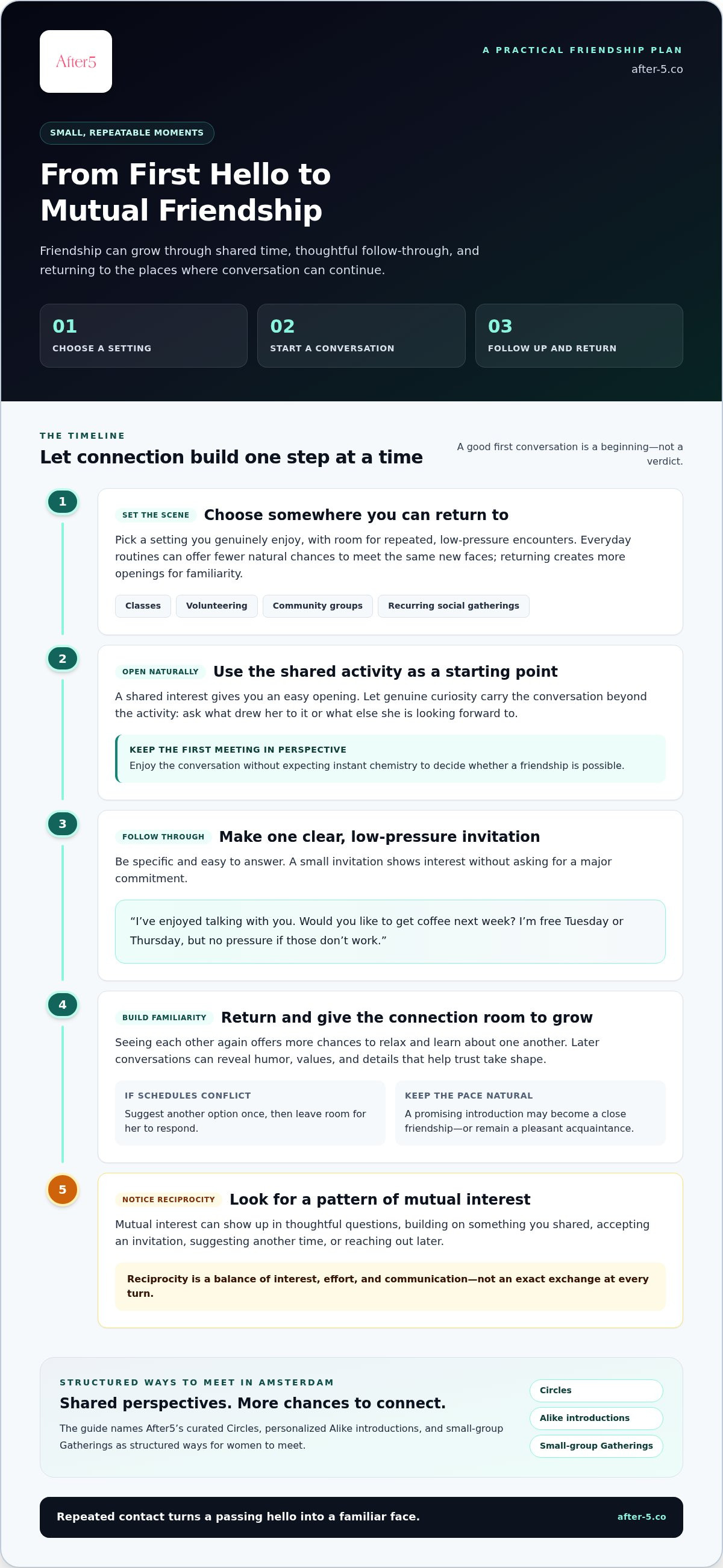
A practical plan for making friends in your 30s without forcing it
A new friendship doesn’t need a grand strategy. It needs a next step you can actually make room for. If you’re thinking about how to make friends in your 30s while balancing work, family, or a full calendar, keep the plan light: choose one setting, show up, start a conversation, follow up, and return.
What can you do during the first few weeks?
Begin with one realistic intention, such as returning to a community group or recurring activity that fits your interests and schedule. In Amsterdam, choose a nearby gathering or activity you can comfortably return to, rather than filling your calendar with new commitments across the city.
At your first meeting, aim for one conversation, not instant best-friend energy. Ask an open question that leaves room for a real answer: “What brought you here?” or “What do you enjoy doing outside of work?” Listen for a shared interest, then build on what she says instead of moving through questions like an interview.
If the conversation feels good, follow up warmly and suggest one clear next step: “I’ve enjoyed chatting. Would you be up for a walk or coffee next week? I’m flexible on the day.” Specific, relaxed invitations are easier to respond to than “We should hang out sometime,” and leave room for either person to suggest another time.
What if you feel awkward, busy, or discouraged?
Nerves are normal. Make the goal small enough to feel manageable: arrive, introduce yourself to one person, or stay for the whole session. You don’t have to be the most outgoing person in the room. Showing up again is progress.
Protect your energy by planning around the time you genuinely have. One recurring commitment you can keep is more useful than several plans that leave you depleted. If a setting doesn’t feel like a fit, treat that as information about the format, timing, or shared interests you want, not proof that friendship is out of reach. Try another suitable setting when you’re ready.
After5 Membership gives women recurring access to curated Circles, personalized Alike introductions, and monthly small-group Gatherings. Learn how After5 Membership creates opportunities to meet and connect.
How to turn new connections into lasting friendships
A promising connection grows through small moments after the first few conversations. Remembering something she mentioned, sending a note before an important day, or sharing a recommendation that made you think of her can show care without demanding constant contact. These gestures say, “I’m glad we’re getting to know each other.”
How do you keep a new friendship growing?
Choose follow-ups that feel natural to you and considerate of her pace. If you talked about trying a new café, send a message when you find one nearby. If you both enjoy a regular walk, suggest making it an occasional routine. Shared rituals create continuity, even if you don’t text every day or meet every week.
Schedules and communication styles may differ. Be warm and direct rather than guessing what a delayed reply means: “I’d love to catch up. Is next week better, or should we find another time?” Then notice whether both of you make room for the friendship over time. It doesn’t need perfectly matched effort at every moment, but it should feel comfortable and mutual overall.
Let closeness unfold. You can share a little more as trust builds, while respecting each other’s boundaries and existing commitments. A friendship can deepen through honest conversations, reliable follow-through, and ordinary time together. There’s no need to rush toward a label or turn every interaction into a test of whether this person will become a lifelong friend.
When can a curated community help?
A natural starting point can make it easier to keep meeting people who feel aligned with your life. Shared interests, perspectives, or experiences give early conversations somewhere to begin, and recurring opportunities can make it simpler to reconnect. That structure can help if you’re considering how to make friends in your 30s but don’t want to build every introduction from scratch.
After5 brings women together through curated Circles organized around shared life phases, lifestyles, and perspectives; personalized Alike introductions based on compatibility and shared interests; and monthly small-group Gatherings that create opportunities for in-person connection. Each offers a different way to meet, with space for conversation to develop naturally.
If a thoughtful, structured approach feels right for this season of life, explore After5 Membership and choose a next step at your own pace.
Make space for the friendships you want
Friendship in your 30s doesn’t need to begin with instant chemistry or a perfectly open calendar. It can grow through shared time, thoughtful follow-through, and the small choice to show up again. If you’re wondering how to make friends in your 30s, start with one setting that feels like you, then let familiarity and mutual interest guide what comes next.
It’s also okay to welcome a little structure. After5 brings women together through curated Circles centered on shared life phases, lifestyles, and perspectives, personalized Alike introductions based on compatibility and interests, and monthly small-group Gatherings designed for in-person connection.
Ready to make room for meaningful connection in Amsterdam? Explore After5 Membership and take the first step toward meeting women who share your interests and perspective.
Frequently Asked Questions
Is it harder to make friends in your 30s?
It can feel harder because work, established routines, and changing priorities may mean fewer natural chances to meet the same people repeatedly. That doesn’t mean you’ve lost the ability to connect or that others aren’t open to friendship. Creating regular opportunities to see compatible people can make connection feel more natural. Start with one setting that fits your life, then give new conversations room to develop.
How do you make friends in your 30s when you work a lot?
Choose a social opportunity that fits around the life you already have, rather than waiting for a suddenly empty calendar. A recurring group near home or work, a shared lunch, or a short walk can make meeting someone feel manageable. If you’re considering how to make friends in your 30s with limited time, focus on one repeatable plan and follow up with people you genuinely enjoy talking to.
Where can I meet new friends in my 30s?
Look for places where conversation can happen naturally and you can return, such as community groups, classes, volunteering, or small-group gatherings. In Amsterdam, After5 offers women curated Circles around shared life phases, lifestyles, and perspectives, personalized Alike introductions based on compatibility and interests, and monthly small-group Gatherings for in-person connection. Choose the format that suits your interests and social energy, then give it a fair chance.
How do I turn an acquaintance into a friend?
Build on what you already share. Mention something you enjoyed talking about, check in, or suggest a simple next step, such as coffee or a walk. Make the invitation specific but flexible: “Would you like to catch up next week? I’m free Tuesday or Thursday.” Notice whether interest and effort become mutual over time. A friendly connection doesn’t need to deepen immediately; let trust grow through genuine conversation and follow-through.
What if I feel awkward trying to make friends as an adult?
Feeling awkward is common, especially when you’re entering a new group or initiating a plan. Give yourself one small goal, like introducing yourself to one person or asking what brought her there. You don’t have to impress everyone or make an instant connection. If a conversation feels brief, that’s okay. Keep showing up in settings that suit you, and let familiarity make future interactions easier.
Can you make close friends in your 30s?
Yes, close friendships can begin in your 30s and continue to deepen through shared experiences, honest conversations, and reliable care. Let closeness build at a pace that feels comfortable to both of you. Share more as trust develops, make time for one another when you can, and communicate kindly when life gets busy. A meaningful friendship doesn’t have to follow a set timeline or look like anyone else’s.
How often should you see someone to build a friendship?
There isn’t one schedule that works for every friendship. What matters is finding a rhythm both people can sustain, whether that means meeting regularly through a shared activity or arranging occasional coffee and checking in between. Consistent contact can help you stay connected, but it doesn’t require constant messaging. Talk openly about busy weeks, suggest another time when plans fall through, and notice whether you both keep making room for the friendship.