


What if a welcoming gathering didn’t depend on being the most outgoing person in the room? Low pressure social gatherings for women work best when thoughtful structure takes the strain out of showing up. Clear details, a comfortable pace, and an easy way into conversation can make the difference between feeling like a guest and feeling like you belong.
If introductions feel awkward or big, high-energy events leave you drained, you’re not alone in wanting connection to feel more natural. You don’t need to impress everyone or leave with an instant best friend. A relaxed setting gives conversation room to unfold, one small moment at a time.
This guide explains what makes a gathering feel genuinely low-pressure and how simple hosting choices can help guests, especially women arriving alone, settle in. You’ll also find practical ways to make attending easier and build in-person connection over time. After5 brings women together through curated Circles and intimate gatherings, giving friendship room to grow at a comfortable pace.
Key Takeaways
- Low pressure social gatherings for women feel easier to join when expectations are clear and conversation can unfold naturally.
- Choose a simple format, a manageable group, and a clear plan so guests know what to expect before they arrive.
- Optional conversation prompts can help guests connect, while mandatory introductions may add pressure.
- A little preparation can make it easier to arrive, join a conversation, take a pause, or leave comfortably.
- Recurring gatherings and thoughtfully matched Circles can help familiar faces become meaningful friendships over time.
Why low-pressure social gatherings for women feel easier to join
Showing up alone can bring a flurry of small questions: Where do I go? How do I start talking? Is it okay to leave early? Those worries don’t mean you’re bad at meeting people. They often mean the gathering hasn’t made its expectations clear.
Low-pressure social gatherings for women are welcoming meetups with clear expectations and room to participate at your own pace, without pressure to perform or instantly bond. A relaxed gathering isn’t entirely unplanned. It has enough structure to help guests settle in, but not so much that every moment feels scripted. You can listen, contribute when you’re ready, and let connection build naturally.
Think of a comfortable café table, a library reading room, or a familiar park. These are examples of third places, settings separate from home and work where people can spend time together. The same welcoming qualities can shape a gathering: an easy-to-understand plan, a warm greeting, and space to join in without needing to prove yourself.
What makes a women’s gathering feel genuinely low-pressure?
Start with clarity. Guests should know what the gathering is, where to arrive, and what to expect. A manageable group makes it easier to recognize faces and follow a conversation. Participation should have more than one shape: speak, listen, or take a quiet moment. A host’s genuine welcome often does more than an elaborate icebreaker. A simple introduction and an invitation to join the group can be enough.
Why large, unstructured events can feel tiring
Large gatherings suit some people and occasions. But when arrival details are vague, a newcomer may have to work out where to stand, who to approach, and how to enter a conversation already underway. In a crowded room, repeating your introduction can take energy, especially if you’re hoping for a more personal exchange. The issue isn’t size alone; it’s whether there’s a clear, considerate path into the gathering.
That’s where relaxed structure matters. A host can greet guests, introduce someone who has arrived alone, and make it clear that stepping away or leaving when needed is fine. Small gestures like these take some of the social work off each guest’s shoulders. Instead of having to create the welcome yourself, you can settle in, notice who’s there, and let conversation find its pace.
How to plan a relaxed gathering that makes conversation natural
A little planning can make a gathering feel easy without making it formal. For low pressure social gatherings for women, the aim isn’t to choreograph every interaction. It’s to remove avoidable unknowns so guests can focus on being present.
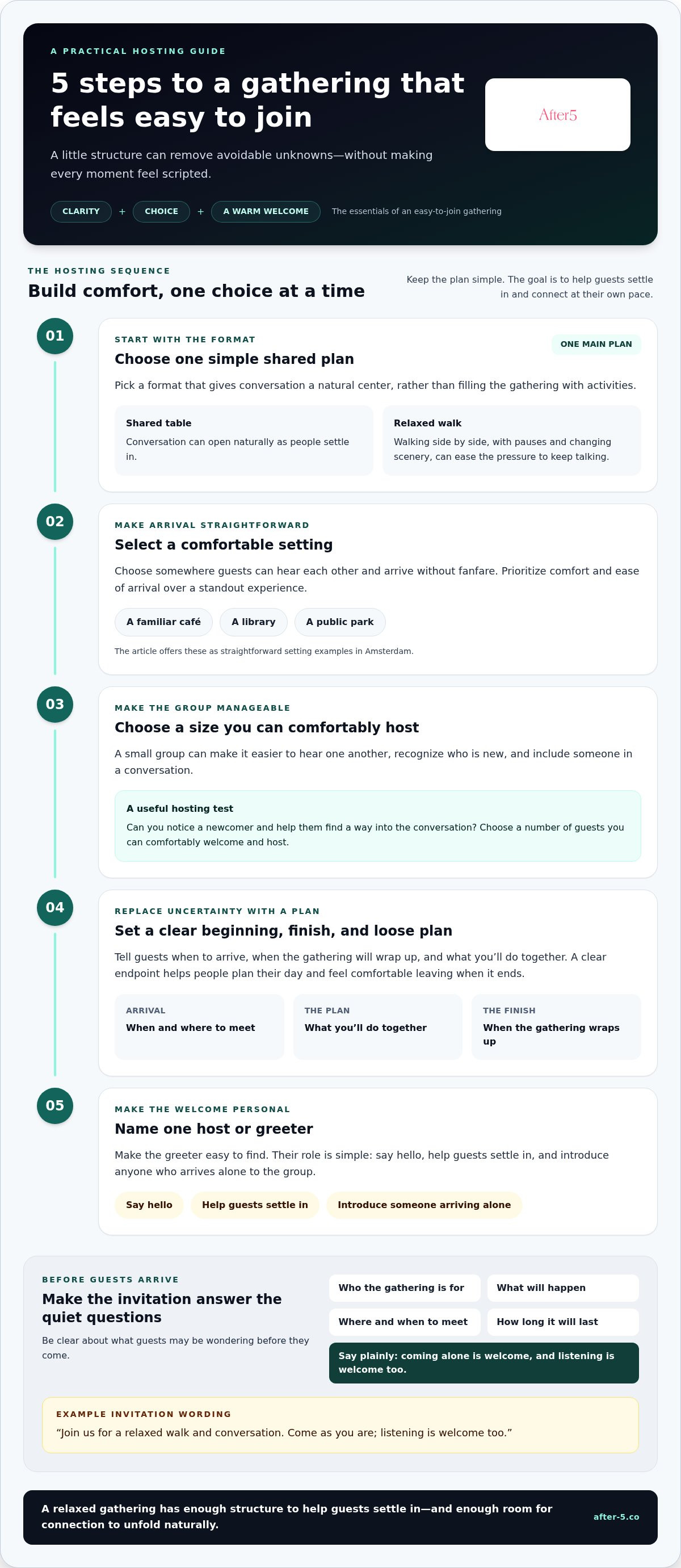
Clarity, choice, and a warm welcome are the three essentials of a gathering that feels easy to join. Use this simple sequence to put them in place:
- 1. Choose a simple format. A shared table gives conversation a natural center; a relaxed walk lets people chat side by side. Pick one main plan rather than packing the gathering with activities.
- 2. Select a comfortable setting. Choose somewhere guests can hear each other and arrive without fanfare. In Amsterdam, a familiar café, library, or public park can offer a straightforward starting point without an elaborate venue setup.
- 3. Keep the group manageable. A small group makes it easier to notice who’s new and include someone in a conversation. Choose a number you can comfortably welcome and host.
- 4. Set a clear beginning, finish, and loose plan. Let guests know when to arrive, when the gathering will wrap up, and what you’ll do together. A clear endpoint helps people plan their day and feel comfortable leaving when it ends.
- 5. Arrange a personal welcome. Name one host or greeter who’ll be easy to find. Their job is simple: say hello, help guests settle in, and introduce anyone who arrives alone to the group.
Choose a simple format and comfortable setting
Let the format do some of the social work. At a shared table, conversation can open naturally as people settle in. On a walk, pauses and changes of scenery can ease the feeling of having to keep a conversation going. In either setting, prioritize comfort and ease of arrival over a standout experience. Guests are there to connect, not to be impressed.
Invite guests with clear, reassuring details
Your invitation can answer questions a guest might hesitate to ask: who the gathering is for, what will happen, where and when to meet, and how long it will last. Say plainly that coming alone is welcome and participation is flexible. For example: “Join us for a relaxed walk and conversation. Come as you are; listening is welcome too.”
If you’d rather join an organized path to connection, After5 membership brings women together through curated Circles, personalized introductions, and monthly gatherings designed for in-person connection. Learn more about After5 membership for friendship and meeting women in similar life chapters.
Which gathering choices reduce pressure, and which can add it?
The right format depends on what helps you feel at ease. A smaller gathering can make it easier to hear one another and find a way into conversation. A larger event may feel more freeing if you enjoy moving between groups. Neither is automatically better. Consider the activity, the guests, and how much social energy you want to spend.
| Choice | May feel easier when… | Possible trade-off |
|---|---|---|
| Small group | You want more space for conversation and a host who can notice newcomers. | A quieter group may feel less lively if you prefer to mingle widely. |
| Large gathering | You enjoy moving between conversations and choosing how long to stay with each group. | It can take more effort to find people and be heard. |
| Optional prompts | You’d appreciate a gentle conversation starter without needing to use it. | A prompt may not suit every guest or moment. |
| Recurring meetup | You like the possibility of seeing familiar faces again. | It asks for ongoing time and commitment. |
| One-off gathering | You want to try something without planning around future meetups. | There may be less opportunity to build on earlier conversations. |
Small groups versus large social events
Smaller groups often offer more room for each person to contribute, and it can be easier for a host to help someone new join in. But there’s no magic group size. A shared activity may work well with a few people—for instance, collaborative team games like those featured on escapemission.ch provide a natural focal point—while a bigger, open gathering may suit guests who prefer to mingle freely rather than stay in one conversation. Match the scale to the format and the people attending.
Gentle conversation prompts versus forced icebreakers
A prompt can give conversation a soft starting point, especially while people are settling in. Try open questions tied to everyday interests or experiences, such as “What’s something you’ve enjoyed lately?” Make answering optional. A round of compulsory introductions or personal disclosures can make guests feel exposed, particularly if they’ve just arrived. Hosts can model a brief, easy answer, then let the conversation move naturally.
Recurring meetups and one-off gatherings offer different kinds of ease. One event can be a simple first step; returning to the same circle can make later conversations feel less like starting from scratch. Choose what fits your capacity now. After5 Circles and small-group gatherings create opportunities for women to connect in person over time.
How to feel more at ease before, during, and after a gathering
You don’t need a perfect plan to feel more comfortable. A few small decisions can replace uncertainty with a sense of choice. Try this before you go:
- Review the invitation for the location, start time, format, expected finish, and host contact details.
- Choose one gentle intention, such as learning someone’s name or enjoying one good conversation. Keep it within your control.
- Pick an arrival time that feels comfortable. Coming alone is a normal way to join, not a sign that you’ve missed a memo.
Before you arrive: make the first few minutes easier
Knowing what to expect can free up attention for the people around you. If you’re unsure where to meet, send the host a brief message beforehand. You might also choose a simple opening line, such as “How did you hear about this gathering?” It’s a starting point, not a script you have to follow. Let yourself arrive as you are.
During and after the gathering: let connection unfold
Focus on listening rather than trying to impress. A small follow-up question, a shared observation, or a warm smile can keep a conversation moving. If you lose your place, it’s fine to say, “I’m going to grab some water,” then return when you’re ready. You can also leave at the stated finish time. Staying longer isn’t proof that you enjoyed yourself.
Afterward, give the experience room to settle. One pleasant exchange can be worthwhile even if it doesn’t become an immediate friendship. If a conversation felt mutual and you’d like to continue it, send a brief, warm message: “I enjoyed talking with you about your new neighborhood. Hope we can catch up again.” There’s no need to follow up with everyone or turn one gathering into a test of your social skills.
For women looking for low pressure social gatherings for women, recurring opportunities can make each meeting feel more familiar over time. After5 membership brings women together through curated Circles, personalized introductions, and monthly gatherings, creating space for in-person connection to grow at a natural pace.
To find a more consistent path to friendship, explore After5 membership.
How recurring, thoughtfully matched gatherings can support real friendship
A first conversation can be lovely and still feel like a beginning. Seeing someone again gives you another chance to pick up a thread, share what’s changed, or discover a common interest you didn’t get to in the moment. Familiarity can make future conversations feel less like a fresh introduction and more like continuing to get to know one another.
Why familiar faces and shared context can help
Recurring gatherings create a natural setting for connection to develop at an unhurried pace. You might remember what someone mentioned last time, ask how a new chapter is going, or find that a shared interest opens up a deeper conversation. No single meetup has to carry the weight of becoming close friends.
Shared life chapters and interests can also make the first point of connection feel more relevant. There may be an easy place to begin, even if everyone’s personality and story are different. Still, seeing someone repeatedly doesn’t guarantee closeness or compatibility. It simply offers more opportunities to find out whether the connection feels mutual.
That’s what distinguishes an ongoing friendship community from networking, dating, or a one-off entertainment event. The aim is not to exchange professional contacts, seek romance, or focus only on the activity. It’s to make room for women to meet, reconnect, and build a sense of belonging over time. For people drawn to low pressure social gatherings for women, that continuity can take some urgency out of each individual meeting.
Explore a curated route to women’s friendship
After5 membership brings several paths to in-person connection together. Members can take part in curated Circles, receive personalized introductions through Alike, and join scheduled monthly gatherings designed as intimate small-group meetups. Shared life chapters, interests, and values help create a thoughtful starting point for meeting women, while recurring opportunities leave space for relationships to unfold naturally.
There’s no need to arrive with a friendship already formed or a particular outcome in mind. A good beginning might be a familiar face, a conversation you want to continue, or simply feeling more at ease in the room. Each is a meaningful step, without a promise of instant closeness.
To explore a recurring community centered on women’s friendship, discover After5 membership.
Make room for connection, one gathering at a time
Meaningful connection doesn’t have to begin with a big entrance or an instant spark. Low pressure social gatherings for women feel easier to join when the plan is clear, participation is flexible, and the welcome is genuine.
Choose a format and group size that fit the kind of conversation you enjoy. Give yourself a simple intention, not a performance goal. One thoughtful exchange can be worthwhile even if it doesn’t become a friendship right away. When you see familiar faces again, connection has room to grow at its own pace.
After5 membership offers a recurring path to in-person connection through curated Circles shaped around shared life chapters and interests, personalized Alike introductions, and monthly small-group gatherings. It’s a thoughtful way to meet women who may understand the season of life you’re in, without expecting every encounter to become an instant bond.
Explore After5 membership to find your next circle and meet women in Amsterdam through a community built around friendship. Explore After5 membership. Your next meaningful connection can start with a simple hello.
Frequently Asked Questions
What makes a social gathering low-pressure?
A social gathering feels low-pressure when guests know what to expect and can take part at their own pace. A clear location, a relaxed plan, and a warm welcome reduce the guesswork. Conversation can develop without mandatory introductions or pressure to impress. For low pressure social gatherings for women, the goal isn’t instant closeness. It’s creating an easy setting where people can listen, speak, and connect naturally.
How do I host a social gathering where women feel comfortable?
Choose a simple format, a comfortable setting, and a group size that suits the activity. Tell guests who the gathering is for, what you’ll do, and when it will end. Name a host or greeter who can welcome people arriving alone and make introductions. Keep conversation prompts optional, and let guests participate in different ways. Clear details and a thoughtful welcome help everyone settle in.
How can I meet women friends without awkward networking?
Look for settings centered on friendship and shared experience, rather than exchanging professional contacts. In Amsterdam, consider small-group gatherings where conversation can grow naturally around shared interests or life stages. After5 is a friendship community for women, with curated Circles, personalized introductions through Alike, and monthly gatherings. These create opportunities to meet in person without making networking the purpose of the interaction.
Are small-group gatherings better for people who feel socially anxious?
Small-group gatherings can feel more manageable for some people because it may be easier to hear others, follow a conversation, and get welcomed by a host. But comfort is personal. A smaller setting can feel intimate to one guest and quiet to another, while a larger event may suit someone who prefers to mingle. Consider the format, clear expectations, and whether you can participate at your own pace.
What should I say when I arrive at a gathering alone?
Start simply: “Hi, I’m [your name]. Is this your first time here?” or “How did you hear about this gathering?” If there’s a host, introduce yourself and ask where to settle in. You don’t need a clever opening or a story ready. A friendly greeting is enough to begin. If the conversation pauses, you can ask someone about the gathering or what they’ve enjoyed lately.
How do I make conversation feel natural at a women’s meetup?
Stay curious instead of trying to perform. Listen to what someone says, then ask a small follow-up, such as “What did you enjoy about that?” Open questions about everyday interests, a recent discovery, or the reason someone came can give conversation a gentle direction. Share a little about yourself too, but don’t feel you need to fill every pause. A quiet moment is part of a real conversation.
Can recurring gatherings help women become friends?
Recurring gatherings give people more chances to recognize one another, continue earlier conversations, and discover common ground over time. That familiarity can make meeting feel easier, but attendance alone can’t guarantee closeness or compatibility. In Amsterdam, After5 membership brings women together through Circles, personalized introductions, and scheduled monthly small-group gatherings. It offers a thoughtful path to ongoing in-person connection, with room for friendship to develop naturally.