


What if belonging didn’t have to begin with a perfect introduction? Women’s community circles offer a quieter way to connect: a shared space to listen, tell stories, and feel seen without needing to perform. Women join for companionship, understanding, and the chance to build trust with others moving through different chapters of life. A circle can start with one conversation and grow through the care people bring to each gathering.
Want connection that feels genuine, not like another obligation? Women’s community circles create space to share, listen, and build familiarity through thoughtful prompts, clear boundaries, and recurring gatherings. This article explains what makes a circle meaningful, how trust and belonging develop, and which activities and traditions can bring people together. It also looks at how ongoing connection can grow from a first conversation.
Key Takeaways
- Circle gatherings can make space for connection, reflection, and creative expression, especially when sharing feels unhurried and respectful.
- Thoughtful prompts and activities give a gathering direction while leaving room for each person to participate in her own way.
- Circle traditions have varied roots; understanding their context can help gatherings feel intentional rather than one-size-fits-all.
- Clear boundaries, attentive facilitation, and respect for personal choice can help trust grow over time.
- Ongoing gatherings create continuity, and After5 Circles offer a way to explore meaningful friendship with women in similar life chapters.
Why Sit in a Women’s Circle?
Women’s community circles bring women together to share stories, listen, and explore a common theme. A gathering might pair a conversation about life changes with journaling, art, or quiet reflection.
Connection and Creative Expression
A circle creates connection through shared attention and offers different ways to express what words alone may not capture. A prompt about purpose, relationships, or work can open a conversation; drawing or journaling gives someone a chance to explore the topic privately before sharing. These activities make room for different styles of participation without expecting everyone to tell the same kind of story. For a woman entering a new life chapter, hearing varied perspectives can make the experience feel less isolating.
Welcoming, Non-Hierarchical Spaces
A welcoming circle makes room for each participant’s voice without treating one person’s experience as the norm. A facilitator can explain the gathering’s purpose, invite people to share in turn, and make passing an option. A first-time participant might listen before speaking, while someone returning shares a recent challenge. This balance can ease the pressure to impress and help trust grow through respectful attention.
Circles can focus on support, wellness, spirituality, or a blend of themes. A support-focused gathering might explore grief or change; a wellness circle might centre on self-care, while a spiritual group could include reflection or ritual.
Circles may overlap with support groups, but they can include creative expression and shared reflection alongside discussion. Unlike a book club, a circle doesn’t need a text at its centre. Unlike a networking group, its focus is personal connection rather than professional exchange.
In a professionally facilitated women’s circle, the facilitator chooses a theme, guides participation, and supports a respectful atmosphere. Topics might include goals, money, conflict, or professional life skills. A session could pair a question about work with journaling, then invite participants to share an insight or simply listen.
To find a professionally facilitated circle near you in the United States, look for local listings using your city and a focus such as support, wellness, or spirituality. Compare the stated purpose, facilitator’s role, and gathering format so you can choose a circle that fits what you want from the experience.
At a first circle, expect an introduction, a shared theme, and time for listening or discussion. Beforehand, consider what you want from the gathering and bring a journal if it suits the format. You don’t need a polished story: a simple check-in, a question, or quiet participation can be enough.
How professionals plan circle activities and sharing prompts
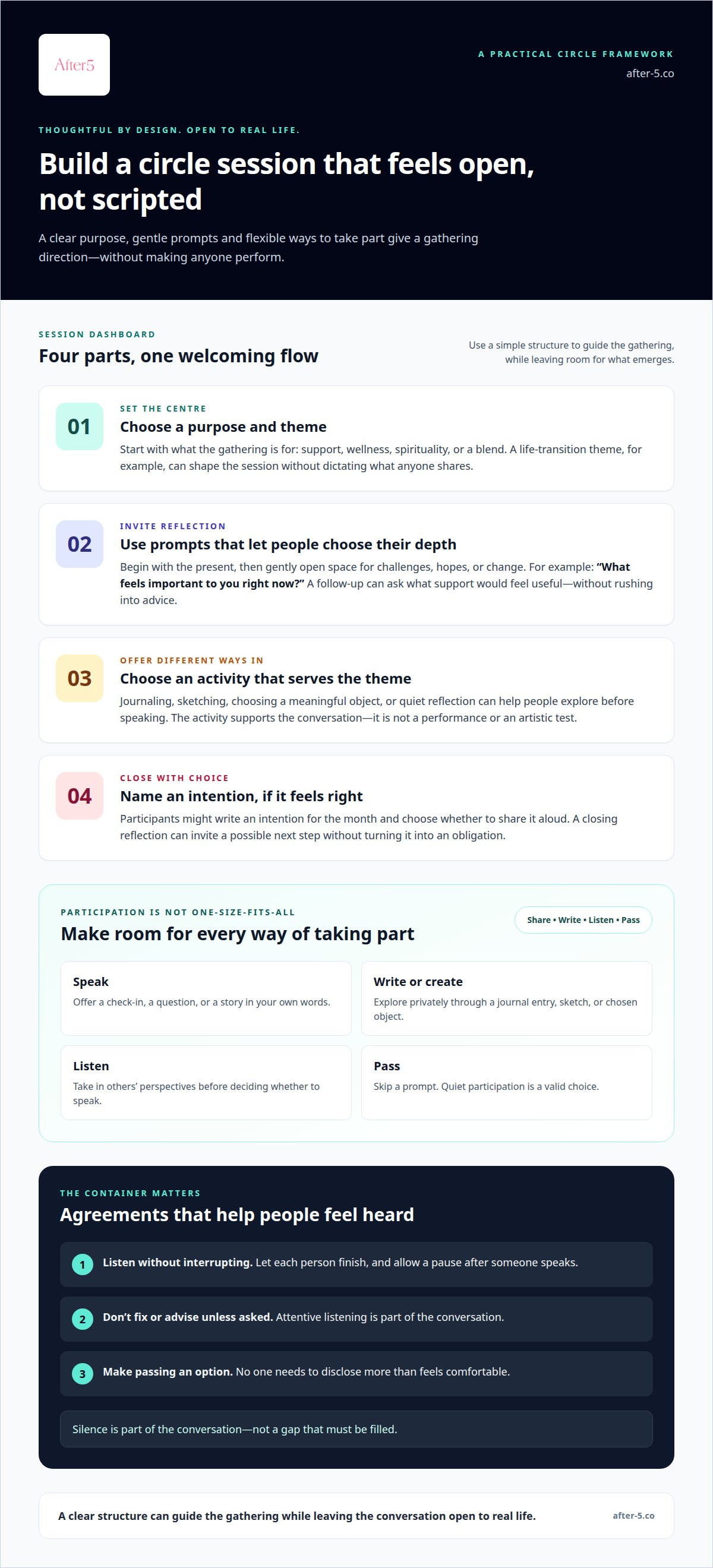
A facilitator plans a circle around its purpose, then chooses prompts and activities to support it. A gathering about life transitions might begin with a brief check-in, move into journaling, and close with each participant naming an intention. This gives the conversation direction without scripting every moment. A thoughtful format also leaves room for speaking, writing, and listening as meaningful ways to participate.
Prompts work best when they invite authentic reflection without demanding disclosure. A broad question such as “What feels important to you right now?” lets each person choose the depth of her answer. A follow-up about what support would feel useful can encourage sharing without rushing toward advice. Professionals can plan prompts in a gentle progression, beginning with present-day feelings before inviting stories about challenges, hopes, or change.
Feeling heard without judgment depends on the group’s agreements and the facilitator’s approach. A circle can agree that participants listen without interrupting, fixing, or offering advice unless someone asks. The facilitator can explain this before sharing begins and model attentive listening by allowing a pause after each person speaks. Silence is part of the conversation, not a gap that must be filled. Participants should also be able to pass on a prompt.
Setting an intention gives a session a clear centre. A facilitator might invite each participant to write an intention for the month, with the option to share it aloud. A guided meditation followed by a journal prompt can create a reflective moment before discussion. In a circle focused on work, for example, the prompt might ask what kind of professional life feels aligned. The facilitator can close by inviting each person to consider one possible next step, without making it an obligation.
Creative activities can make sharing easier when direct conversation feels difficult. A facilitator might invite participants to sketch a feeling, choose an object that represents a theme, or write a short reflection before speaking. These options offer different ways into the same conversation. The activity should serve the circle’s purpose, not become a performance or a test of artistic skill.
For women seeking continuity, an ongoing circle experience can make space for connection to deepen across gatherings. A clear theme, thoughtful prompts, and room for silence help each moment feel intentional while leaving the conversation open to real life.
Ancestral and spiritual origins of women’s circles
Some women’s circles draw on gathering traditions associated with lunar cycles, menstrual cycles, and significant times of year. Accounts of these practices reach back thousands of years, when female ancestors gathered in community. These histories offer context, not one origin story shared by every circle. Today, a gathering may be spiritual, reflective, or simply focused on connection. Understanding a ritual’s context helps participants consider its meaning and choose practices thoughtfully.
The moon shapes the timing of some circle traditions. Jewish women observe Rosh Chodesh at the first sliver of the moon, marking the “head” of the month. Other circle traditions connect menstruation with the lunar cycle, from new moon to waning crescent. These are distinct cultural and spiritual frameworks, not interchangeable customs. A thoughtfully facilitated circle explains a practice’s meaning rather than presenting it as universal.
Accounts also place pagans and Celtic Christians in women’s circles during the 5th and 6th centuries. That historical detail shows how gathering practices have appeared within different spiritual settings. It doesn’t mean every modern circle follows pagan or Christian traditions. A group might instead explore personal ancestry through stories, family memories, or a reflection on values passed between generations. Respectful context keeps spiritual exploration open without flattening different relationships to tradition.
For participants interested in ancestral connection, a circle can make remembrance tangible. A facilitator might invite each person to share a family saying, a meaningful practice, or a value she hopes to carry forward. One person could describe a shared meal from childhood; another might reflect on how care was expressed in her family. These examples bring history into everyday life without asking anyone to claim a tradition that isn’t hers.
Ritual can give a gathering a clear beginning or close. A circle might pause for quiet reflection, mark a seasonal change, or set an intention for the month ahead. New moon rituals are used to set intentions, while full moon rituals can focus on releasing old habits or limiting thought patterns. These practices suit participants who connect with lunar symbolism. A secular group can create continuity with a shared moment of silence or a closing reflection instead.
For women’s community circles, the practical question is how a tradition serves the people gathered now. A facilitator can name a ritual’s context, explain what participation involves, and make it optional. This approach respects spiritual meaning while leaving room for different beliefs. The gathering can feel intentional without asking everyone to share the same history, faith, or relationship with ritual.
Confidentiality, trust, and safety in circle gatherings
Trust grows through clear agreements, consistent facilitation, and respect for each participant’s choices. Before sharing begins, a facilitator can explain how the group will handle personal stories. For example, participants might agree not to repeat identifying details outside the gathering. This sets a shared expectation without suggesting that one person can control what others say later. Clear language matters, especially when conversations touch on relationships, family, or work.
A welcoming space also needs boundaries around participation. The facilitator can invite each woman to speak, listen, or pass without asking her to explain her choice. If someone shares a difficult moment, others can listen rather than interrupt with advice. The facilitator can restate the group’s agreement if conversation shifts towards fixing or judgment. These visible actions make respect practical, not just an intention stated at the start.
Physical details shape comfort, too. A quiet room with seats arranged in a circle helps participants see one another and follow the conversation. The facilitator can explain the gathering’s purpose, outline the activity, and tell participants how to pause or step away. A journal prompt about self-care may feel personal; offering the choice to write privately or share aloud respects each person’s pace.
Safety also means noticing how power operates in the room. A facilitator can make space for quieter voices, prevent one participant from dominating, and avoid treating any one life experience as universal. If someone shares a story about conflict at work, the group can listen without turning her experience into a lesson for everyone. This supports meaningful conversation while keeping each person’s story her own.
Some women’s circles draw on ancient gathering traditions, but safety depends on what happens in the room now. A spiritual ritual, such as a moment of silence, should be explained beforehand and offered without pressure. The facilitator can distinguish a shared practice from personal beliefs so participants understand the invitation. This clarity helps everyone choose how to participate.
Before closing, a facilitator can review the group’s agreements and invite participants to share what helped them feel comfortable. One person might value being able to pass; another might appreciate knowing that advice wasn’t expected. This feedback gives the facilitator practical ideas for future gatherings. Repeating the same boundaries at each meeting also builds continuity, allowing trust to grow through consistent actions rather than promises alone.
Building community through ongoing gatherings
One gathering can spark connection, but returning gives relationships room to develop. In a monthly mother’s circle, a familiar rhythm lets participants notice what has changed since their last conversation. One woman may share a new challenge; another can remember her earlier hopes and ask how they’re unfolding. Over time, separate conversations become shared history, and trust can grow through continued attention.
Repeat gatherings also make participation easier to navigate. At a first meeting, a woman might mostly listen; later, she may feel ready to share a story or ask for perspective. A familiar format means there’s less to figure out each time. A facilitator can welcome newcomers while maintaining the circle’s agreements, helping both regular participants and first-timers find their place.
Attendance alone doesn’t build a community. Connection grows through small acts of follow-through: remembering a detail, making room for a quieter voice, or asking about an intention shared earlier. Jean Shinoda Bolen describes the experience of a circle extending into women’s relationships beyond the gathering. Participants can carry its listening and mutual encouragement into conversations with friends, family, and colleagues.
A first circle can start simply. One account describes six women gathering in a Colorado town; college women who facilitated Girls Circles later joined women’s circles using the same format. These examples show how a repeatable structure can work in different settings. A familiar opening, shared theme, and closing reflection can help a group create its own identity without making every gathering identical.
Ongoing gatherings let wisdom move in more than one direction. A woman facing a career change may hear from someone who has navigated a similar transition, while offering her own perspective to another participant. The group doesn’t need to supply one definitive answer. Shared stories can help members consider options, recognise their own experiences, and stay connected as circumstances change.
For women seeking that continuity, explore gatherings designed for ongoing connection. A meaningful community takes shape as people return, listen with care, and carry what they learn into their wider relationships.
A Women's Circle is a support group where women share, explore, build skills, and encourage one another to live authentically. Its format can suit people at different stages: college women who facilitated Girls Circles in local communities later took part in their own Women's Circles using the same format. The author’s first women’s circle in her Colorado town brought together six women, showing how a small group can begin to build a community through shared participation.
The organizers held two Sacred Moon Women's Circle events, each with over 20 women attending. The author also co-led a birth story-sharing circle with local doula and Curanderismo practitioner Morgan Rodríguez, who led a cacao ceremony. These gatherings offer different ways to bring women together around shared reflection and experience. The page suggests holding a women’s circle around the full moon monthly, giving participants a recurring occasion to reconnect. Whether centered on a theme or an open exchange, a steady invitation can help members know when they can return, contribute, and encourage one another.
After5: Circles
After5 offers Circles for women looking to build meaningful friendships through shared conversation and connection. If you’re ready to meet women in a similar life phase, these curated small-group gatherings can be a natural next step after exploring what makes a circle feel welcoming. After5 also offers Membership, Gatherings, and Alike, with personalized introductions shaped around shared values and interests. The focus is friendship, not professional networking or dating. Consider Circles when you want connection to grow through in-person gatherings rather than one-off conversations. For a thoughtful next step, contact After5 to explore Circles and find a way to begin that feels right for you.
Make room for your next connection
Your next chapter doesn’t need a grand plan. It can begin with a conversation, a familiar face, or the decision to make space for friendship. Women’s community circles offer a way to keep connection intentional as life shifts, while leaving room for each person to arrive as she is. Let curiosity guide the next step. Notice what kind of connection feels right now, and choose an opportunity that fits your pace.
After5 offers After5 Membership, Gatherings, and Circles for women seeking meaningful friendship. If you’re ready to meet people whose values and life chapters resonate with yours, explore a way to connect that feels natural. No perfect words required. Just a willingness to begin.
Connect with After5 about your circle, and take the next step toward a wider, more connected world.
Frequently Asked Questions
What are the benefits of joining a women's community circle?
Joining a circle can offer companionship, fresh perspectives, and a regular place to reflect with others. A woman navigating a career change, for example, might hear how peers approached similar decisions and leave with ideas to consider. A circle can turn an interest in connection into shared conversation. Its value comes from mutual participation, not from expecting the group to solve every personal challenge.
How do professional facilitators start and lead a women's community circle?
Professional facilitators begin by shaping a clear purpose, then plan an opening, a central activity, and a closing reflection. In an Amsterdam circle focused on life transitions, they might invite a brief check-in before a guided prompt. During discussion, they keep participation balanced and make room for listening as well as speaking. A thoughtful closing helps participants leave with a sense of what they want to carry forward.
What rules and confidentiality practices do women's circles use?
Groups often agree to listen respectfully, avoid unsolicited advice, and treat personal stories with discretion. A facilitator can explain these expectations before discussion and clarify that participants should not share identifying details outside the circle. These agreements support trust, but they can’t guarantee that others will keep every disclosure private. Consider sharing only what feels comfortable, especially when a story involves another person or sensitive details.
What safety, privacy, or inclusivity concerns should I consider before joining?
Consider whether the circle’s stated purpose, format, and participation expectations feel comfortable for you. Look for clear ways to pass on a prompt, raise a concern, or take a pause. Notice whether the facilitator makes room for different backgrounds, identities, and experiences without asking anyone to represent a whole group. In Amsterdam, After5 Circles bring women together around shared life phases and perspectives, offering one option for friendship-focused connection.