


What if close friendship in a new city begins not with instant chemistry, but with seeing the same people again? Women friendship after moving cities can feel harder than expected: familiar routines are gone, friendly conversations don’t always turn into plans, and a full calendar makes it easy to put connection off.
If you’re wondering how to make close women friends after a move, you don’t need to force instant intimacy or say yes to everything. Trust grows through small, repeated moments: a familiar face at a regular gathering, a simple invitation, or a conversation that picks up where it left off. That’s how an unfamiliar city can start to feel like yours.
This guide shares practical ways to meet women locally, build familiarity at a comfortable pace, and create a social rhythm that fits real life. You’ll also learn how After5’s curated Circles, personalized Alike introductions, and small-group Gatherings can offer an intentional starting point. One genuine connection at a time, your new city can become a community.
Key Takeaways
- Feeling disoriented after a move is understandable: familiar routines and everyday encounters often disappear along with old friendships.
- For women friendship after moving cities, prioritize repeat contact in shared settings so familiarity and trust can build gradually.
- Compare recurring community settings, existing acquaintances, work-adjacent connections, and curated introductions to find an approach that fits your energy and lifestyle.
- Use a flexible first-month roadmap: orient yourself, choose a recurring setting, follow up, and notice what feels natural.
- After5 Membership brings together personalized Alike introductions, Circles, and scheduled monthly Gatherings for recurring connection.
Why women’s friendship can feel harder after moving to a new city
A move can be exciting and disorienting at once. There are new streets to explore and a fresh chapter to shape, but familiar people may no longer be nearby for an ordinary Tuesday. You can feel grateful for the change and still miss the ease of your old social life. Both feelings can be true. Struggling to feel rooted doesn’t mean you’re unlikeable or doing anything wrong; it means the everyday structures around connection have changed.
In the early stages of women friendship after moving cities, the challenge is often less about meeting people and more about turning an introduction into familiarity. The broader experience of friendship through a new life chapter can include uncertainty as well as possibility. Give yourself room to adjust while you begin building a local rhythm.
- Everyday invitations and spontaneous catch-ups are suddenly farther away.
- Familiar places and routines no longer bring you into easy contact with the same people.
- New conversations may feel pleasant but stop before either person follows up.
- A full schedule can push social plans to “later,” even when connection matters to you.
What changes when your social life moves with you
Friendship is woven into small, repeated moments: recognizing someone at a regular spot, sharing a quick update, or being included in a plan without having to organize it from scratch. After a move, familiar places and shared histories may no longer be close by. You’re building a sense of belonging while also learning the pace of a new city.
Messages and calls with old friends can be a real comfort. They keep shared history close, but they can’t always offer local companionship, such as someone to explore a neighborhood with or invite for a spontaneous coffee. That gap is part of adjusting to a move, not proof that you’ve failed to make friends.
Why a first conversation rarely becomes a friendship on its own
A warm first conversation is a beginning, not a promise of instant closeness. You might meet a woman at a class, through work, or at a neighborhood gathering and enjoy talking, then part ways without a clear next step. Without another chance to connect, you have little opportunity to learn what you share or become more at ease with each other.
Repeat contact is a practical foundation for friendship: it gives familiarity, trust, and follow-up room to grow. A broad understanding of the concept of friendship includes relationships shaped over time, not just a single positive encounter. Look for low-pressure ways to meet again, such as returning to a shared setting or suggesting a simple follow-up.
How to build familiarity and connection in a new city
Familiarity grows when you become a recognizable face in a shared setting, without needing every encounter to turn into a deep conversation. A quick hello at a recurring activity, a chat before it begins, or a familiar smile on the way out can make the next interaction easier. These small moments create a bridge from stranger to acquaintance.
Shared context helps, too. When you’re both attending a recurring gathering or exploring the same neighborhood routine, there’s already something to talk about. Ask how someone found the activity, what she enjoys about it, or whether she’s been before. No elaborate opener is needed.
For women friendship after moving cities, the goal isn’t to fill every evening with plans. Choose a social setting you can return to comfortably. A familiar weekly rhythm can create more room for connection than a packed calendar of one-off outings.
- A regular neighborhood routine, such as visiting the same market or taking a walk at a familiar time.
- A community activity that fits your interests and feels comfortable to attend again.
- A recurring gathering where the same people have a natural chance to cross paths.
Choose places and routines you can return to
Start with what suits your life: your interests, schedule, energy, and preferred level of interaction. If you’re in Amsterdam, look for recurring activities in your neighborhood or along a route you already travel. A long journey can make it harder to show up regularly. A one-off outing may be enjoyable, but a repeating setting gives familiar faces a chance to reappear.
Before committing, ask yourself: could I picture coming back on an ordinary week? Choose one manageable option and give it a few visits. Consistency matters more than trying every gathering in the city.
Turn a promising conversation into a second meeting
If a conversation feels easy, follow up with something specific you discussed. For example: “You mentioned wanting to explore the area. Would you like to take a walk sometime next week? I’m free Tuesday or Thursday, but another time works too.” The invitation is clear, connected to your conversation, and flexible without putting pressure on either person.
If she declines, it doesn’t have to be a judgment about you or her. She may be busy, or the timing may not work. Leave the door open warmly and keep showing up in shared settings. For a more structured way to meet women in a new city, After5 Membership brings together personalized introductions, Circles, and scheduled monthly Gatherings.
Which ways of meeting women suit your new-city life?
There isn’t one ideal route to new friendships. The best fit depends on your schedule, how much initiative feels comfortable, and whether you prefer spontaneous conversation or a little structure. If it seems as though everyone in your new city already has their people, remember that familiar groups aren’t always closed. A friendly invitation or shared activity can still make space for new connections.
Use this comparison to see which settings offer the kind of contact you want. The effort level is a general guide, not a rule; your experience will depend on the people and setting.
| Route | Repeatability | Shared context | Social initiative |
|---|---|---|---|
| Recurring community setting | Often high | Activity or local interest | Low to medium |
| Existing acquaintances | Varies | Mutual friends or past connection | Medium |
| Work-adjacent connections | Can be regular | Industry or professional life | Medium |
| Curated introductions | Depends on the format | Shared interests or life phase | Low to medium |
Choose an approach that matches your energy and routine
On a low-energy week, choose a manageable plan with a clear shared context, such as returning to a community activity you already enjoy. You don’t need to turn every free evening into a social opportunity. A routine that feels easy to repeat is more likely to fit your life than an ambitious schedule that leaves you drained.
If you enjoy spontaneity, let informal invitations complement that steady anchor. Say yes to a casual coffee, or invite someone you’ve met to join you for a walk. More than one route can work, but connection isn’t a numbers game. Notice where conversation feels natural and where you’d like another chance to talk.
When a curated introduction can make starting easier
A shared interest or life phase gives an introduction a natural starting point. Instead of searching for a topic from scratch, you can talk about what brought you together, then discover what else you have in common. Small groups can also provide a shared setting for women who find one-on-one introductions easier with others around.
After5 offers personalized Alike introductions and Circles centered on shared life phases, lifestyles, and perspectives. They provide a thoughtful starting point for meeting women with common ground. If you’re exploring women friendship after moving cities, consider what would make showing up simpler: a familiar community routine, a connection through someone you know, or an introduction with shared context.
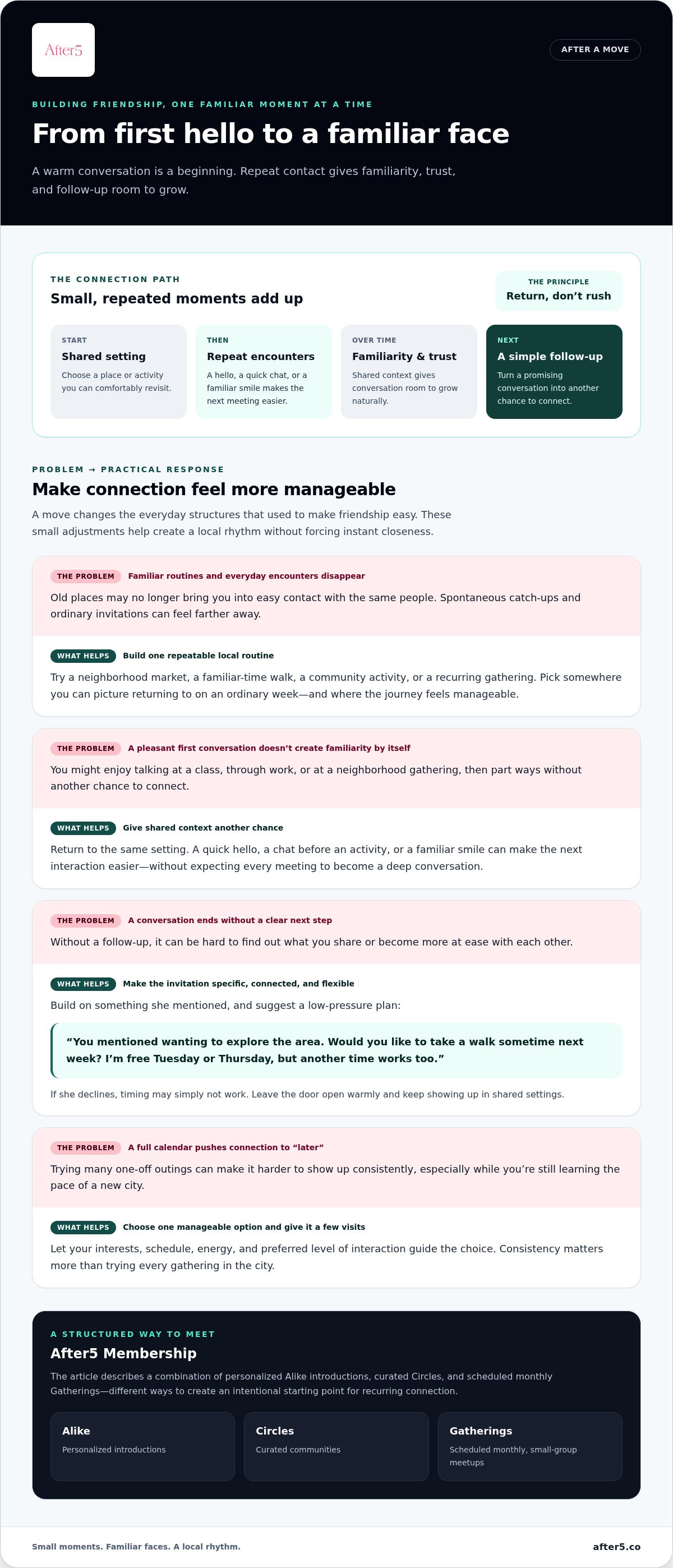
A gentle first-month roadmap for making women friends after moving
Think of the first month as a chance to test what helps you feel more at home, not a deadline for finding a best friend. Progress in women friendship after moving cities may look like recognizing a few faces, having a conversation that continues next time, or finding one social plan you’d genuinely enjoy repeating. Let the pace be flexible.
- Orient. Notice what you want from a local social life and what feels realistic right now. Look at your ordinary week: when do you have energy, and which neighborhoods or activities are easy to reach? You don’t need a perfect plan. A couple of possible time windows can help you choose a first step that fits.
- Choose a recurring setting. Pick one community activity or gathering that suits your interests and schedule. Return before deciding whether it’s right for you. A familiar setting can make the next visit easier, while sampling too many options at once can leave little energy to follow up.
- Follow up. If you enjoy talking with someone, send a warm, specific message. “I liked hearing about your favorite walks. Would you like to explore the park sometime next week?” is enough. Offer a simple plan and flexible timing, then give the other person room to respond in her own way.
- Review what feels natural. At the end of each week, ask: Did this plan give me energy or use more than I had? Was I genuinely interested in returning? Did the setting make conversation feel comfortable? Use your answers to repeat, adjust, or try a different approach.
Start small: build a local rhythm before expanding it
Choose a realistic window or two for connection in an ordinary week rather than planning every evening. Return to one suitable setting and make a manageable invitation when a conversation feels promising. You don’t need to wait until you feel completely confident; a simple coffee or walk can be a gentle first step. If you’re in your 30s, work, routines, and priorities may shape what fits, so explore this guide to making friends in your 30s for age-specific perspective.
Follow up, notice reciprocity, and adjust gently
Reciprocity isn’t a strict tally of who messaged first or how quickly someone replied. Look for mutual interest over time: she asks questions, responds warmly, or suggests another plan. If that energy isn’t there, don’t turn it into a verdict about yourself. Try a different setting or invitation, and keep the process light enough to sustain.
If recurring connection would make this roadmap easier to put into practice, explore After5 Membership, which includes personalized introductions, Circles, and scheduled monthly Gatherings.
How After5 can help you find friendship after moving cities
Starting over socially doesn’t mean you have to figure out every introduction yourself. After5 is a friendship platform for women who want thoughtful, recurring opportunities to connect in person. It brings shared context and repeat contact together, two useful ingredients when you’re building a local circle from scratch. Not every introduction will become a friendship, but intentional ways to begin and opportunities to meet again can make it easier to keep building connection.
What membership offers when you are starting from scratch
After5 Membership includes personalized Alike introductions, Circles, and scheduled monthly Gatherings. Each offers a different starting point, so you can choose the kind of connection that feels most comfortable. An introduction can make the first hello easier; a Circle offers shared perspective; a Gathering creates space to connect face-to-face.
Alike offers personalized friendship introductions based on compatibility and shared interests. That common ground can give a first conversation a natural opening, whether you discover a shared interest or recognize a similar chapter in life. It’s a thoughtful introduction, with room for the connection to develop naturally.
Circles are curated around shared life phases, lifestyles, and perspectives. They give members a context for connecting with women whose experiences or outlook may feel familiar. Gatherings are small-group meetups designed for face-to-face connection, with scheduled monthly opportunities that give conversations room to develop. Together, these elements offer more than a one-off hello: they create different ways to meet and reconnect.
Picture arriving in Amsterdam with a full schedule and few local connections. A personalized introduction can offer a clear first step, while a Circle or scheduled Gathering adds shared context and another chance to connect. That structure can make getting started more manageable without turning every free evening into a social plan.
Take a low-pressure next step
Consider what would feel useful right now. Would a personalized introduction make it easier to start? Would a Circle shaped around a shared life phase help you feel more at ease? Or would scheduled, small-group Gatherings fit the social rhythm you want to build? Meaningful connection develops at its own pace, and a new city can begin to feel more familiar one genuine encounter at a time.
If this kind of thoughtful structure feels right for your next chapter, explore After5 Membership and see how its introductions, Circles, and Gatherings can support the way you meet women locally.
Make room for the connections you want
A new city doesn’t have to feel like home all at once. Let belonging take shape through the people and places you choose to return to. One conversation can become a familiar face, then a shared routine, then a connection that feels like part of your life. That’s a gentle way to approach women friendship after moving cities: stay open, take small steps, and let trust grow in its own time.
After5 Membership brings together curated Circles, personalized Alike introductions, and small-group Gatherings designed for face-to-face connection. It offers structure for meeting new people while you settle into Amsterdam, with different ways to start and reconnect. Choose the pace and approach that feel right for you.
Explore After5 Membership to find thoughtful introductions, Circles, and Gatherings for building local connections in Amsterdam. Your next chapter can hold fresh conversations, familiar faces, and a growing sense of belonging.
Frequently Asked Questions
Is it normal to feel lonely after moving to a new city?
Yes, loneliness can be a normal response to losing familiar people, places, and routines at once. It doesn’t mean you’re bad at making friends or that your move was a mistake. If women friendship after moving cities feels slower than you expected, try naming what you miss specifically: casual company, practical help, or someone who knows your history. That can help you seek the kind of connection you need in Amsterdam.
How long does it take to make friends after moving?
There’s no universal timeline. A pleasant acquaintance may appear quickly, while a close friendship usually needs time, shared experiences, and mutual effort. Instead of setting a deadline, notice small signs of progress: you recognize someone, feel more at ease starting a conversation, or both make an effort to meet again. If your first connections in Amsterdam are still casual, that can be a meaningful beginning rather than a failure.
Can I stay close to old friends while making new ones?
Absolutely. Keeping old friendships and growing local ones can support different parts of your life. Agree on a simple way to stay in touch, such as a regular voice message or a shared photo thread, while leaving room for plans with people nearby. You don’t have to divide your loyalty. A familiar friend can remain part of your support system as you discover who you’d like to get to know in Amsterdam.
What should I say when inviting someone I just met to meet again?
Be warm, specific, and relaxed. Try: “I enjoyed chatting with you about your book recommendations. Would you be up for swapping ideas over lunch sometime next week?” If lunch feels like too much, suggest a brief call or another easy activity connected to your conversation. Offer a couple of possible days and let her know you’re flexible. A clear invitation gives her something easy to respond to.
How can introverted women make friends after relocating?
Choose formats that let you participate without having to carry the whole conversation. A small group, a shared activity, or a one-to-one introduction may feel more comfortable than a large, unstructured mixer. In Amsterdam, consider what fits your energy and travel routine, then plan a quiet reset afterward. You can aim to speak with one person and leave when you’ve had enough. Social progress doesn’t require being the most outgoing person in the room.
Should I make friends through work after moving?
Work can be one route, especially if you enjoy talking with a colleague beyond project tasks, but it doesn’t need to be your only source of friendship. Keep invitations casual and respect professional boundaries: a conversation at lunch can show whether you share interests outside work. Building connections beyond your workplace also gives your social life more variety in Amsterdam, so your sense of belonging isn’t tied to one setting.
What if I try a social activity and do not click with anyone?
One activity that doesn’t lead to a connection isn’t a verdict on you or the whole city. The format, timing, or mix of people may simply not suit you. Ask yourself whether you enjoyed the activity itself, felt comfortable there, or would rather meet people in a smaller setting. You can try it again, adjust your approach, or choose a different context. In Amsterdam, let each attempt offer information, not pressure.